Search This Blog

Wednesday, June 26, 2013

Skyfall
2012


A largely commercial venture that caters to the Superman crowd, I could not take this as seriously as a Mission Impossible, for instance.  There were too many panderings to Cinametique, and the whole thing was just way too long.  It stretched and stretched it seemed.  I could have edited this down and chewed off at least 40 minutes.  Plus it was all way too obvious as far as progression of plot.  The mystery just wasn't there.

Javier Bardem played his role magnificently, as would be expected.  He makes a great bad guy.  But the clownish blonde hair and the CG teeth...man.  I'm thinking as well that Javier felt a little out of his element here as he's been involved in some very serious roles in the past with No Country, Biutiful, and  To The Wonder (ok, we'll not count "Between Your Legs").  The security setup with him in the glass cage (with no potty to go in) was way ridiculous, as well as the moment with him on the ladder being shot at 5 times by Bond and evidently Bond claiming that he missed on purpose.  The explosion in the ceiling of the tunnel and the crashing of the train with its lights still on during the whole ordeal and no one on board the train in evidence was quite amateurish, no matter how much they spent on the scene.

The only delightful thing about the film, really, was the opening, and the credits were fantastic.  I think credits are becoming a category for the Oscars in themselves.  "For Best Credit Sequence in a Feature Film, the statue goes to...."  I actually like Adell's song for this movie, it was perfect for the pace of the credits as well.  Smooth baby.

Cannot say I'd ever watch again though.  Only a few fun moments, otherwise most of it lost in being filmy and Hollywoodish.  Lots of money, no results.  Oh, but at least a cool retro car in the end, and like a rock group and their guitars, they have to smash it of course.  Sorry, that's my spoiler.

1.5 stars of 5

Thursday, June 20, 2013

Push

a novel by Sapphire
rel. date: June 1996

The reality of this world is too harsh for most, even in our minds mostly not comprehending the clarity with which this short but powerful work takes us to.  You imagine that it’s there, the dirty apartments, the dark halls, the cooking smells, the desperate people.  But mostly we don’t want to imagine, we don’t let enter our waking consciousness the incestuous, rapist father, the 400 pound abusive mother who would actually kick her own girl while she’s having a baby on the kitchen floor, then send the baby off to live with a grandmother because it’s retarded and she only wants the welfare money.  We can imagine the school where something/someone like this would go unnoticed, and not really be educating a child like this, but we cannot imagine what it is really like to be this person, to be this child.

Sapphire’s language choice, some critics would say, “pushes” the boundary between realism and sensationalism, a kind of Maury Povitch flavor to it.  You’d think that Precious and Mama would be guests on his show.  Precious is on stage first trying to tell Maury all about her life with this woman, and occasional man named Carl, in her broken BEV, which half the audience relates to in any case, and most understand because Maury is translating and helping along by asking pointed questions.  At key moments there are the TV monitors showing Mama’s reaction back stage, and occasional boos from the audience for the woman.  Then they bring her out to meet with Precious in front of everyone, and Mama tries to explain it away, the same way she tried to explain it to the social worker, who was horrified, and saw right through the disguise.   Near the end of the show it might be one of those scenes where both people are standing and flailing accusations at each other and security guards are keeping them apart, a spectacle for TV.

Well, that’s sensational, but it’s also very real.  This voice is real, although it is one that we do not like to hear.  These situations are real, and happen every day, in many ways that we may not imagine.  
You cannot come away from reading this without a heightened sense of awareness of the plight of the poor and the inner city life of the underprivileged.  The descriptions even of simply walking through neighborhoods, the broken tenements and dives of Harlem, are haunting.  This is a voice that while difficult for us to turn our face to, we need to continue to do so.

I’d like to “rate” this book, or compare it, but I cannot at this time.  What “scale” does one use to “rate” something like this?  What criterion?  What frame of reference?  All I think I can tell you is:

Not for youth or light reading.  Please be of a mature mind and solid heart if you undertake to read this book.

Thursday, June 13, 2013

Home

a novel by
Marilynne Robinson
rel: 2008

Farrar, Straus and Giroux publishers


Home

An almost unutterably and grievously sad tale of longing, heartbreak, and their attendant truth.  This is the sequel to Gilead, Robinson's novel of a small town by that name, and 2 ministers who polarize yet orbit one another, much like the necessary bond of an Oxygen molecule, sharing an equal number of electrons.  But Home is another step, the polar perspective to Gilead.

Home winds us not through history or the townspeople, except for those necessary to the central tale, and not through a miasma of family ties either, like old scrapbooks that are simply interesting to the family members, and neither does it give way to narrative by way of events that keep us in suspense by their interweaving, as some fiction does.  It does have history, people, family, and a narrative that is definitely present, and leaning towards mystery, yet without any of those structures being the main support beam.  Instead, it takes us through the intricate, interwoven, and sometimes broken tapestry of the relationships that are born in a home, hence the title.  The other goal that this work so masterfully achieves is the unraveling of the mystery of faith in the individual, the nature of it, the impossibility of it in the face of our condition, and the inevitability of it only because of grace, and our ultimate submission to it.

Jack Boughton, the scion of the first book, the truly prodigal son of Reverend Boughton, comes Home, and this is the story from inside his house, a reversal of the perspective of Reverend Ames in the novel Gilead. For Jack to return, it has required a great deal of time away, and effort of will, battling the most supreme enemy of them all, destitution.  Purposes and motives are revealed, peeled back, one paragraph at a time, at times seeming to plod, and bringing us to a place of repetitiveness it would seem, but only for a moment, and then we realize that we're not reading the same thing again, with the same people, but it's delightfully different, deeper, sometimes darker, yes, but more intriguing than what we were expecting, more exacting, more closer to….home.

That's the scary thing really.  This painstakingly careful work of literary genius is surgical in its insistence that we face the human, ourselves, and although few of us might actually be in the exact relationships that these 3 people find themselves, that is only a stage and a backdrop to the play that we face when we put the book down for awhile and allow the haunting of the work to echo in our own reality.  I guarantee you that you will at some moment in the reading of this novel find a relational resemblance to something in your own life that bears bringing out from its possibly closeted inner sanctum for examination.  I also guarantee that because of the grace of the work that you will find a solace in it that will make it worth the effort.


Read this novel after Gilead.  If you have not read Gilead, or my review of Gilead, the Pulitzer Winner, please feel free to find it here: Gilead Review

Sunday, June 09, 2013

Prometheus

2012

Ridley Scott

Charlize Theron, Logan Marshall-Green, Noomi Rapace, Michael Fassbender

You'd think Alien would have run it's course as a three time film franchise.  It's been since 1979 since the first Alien popped out of a stomach and into a man's birthday cake, and today we still have acid blood that eats through helmets, and snake-like creatures that dominate men and seem to like esophegii.

But what we do not have in this film is cheesy effects and off-screen suspense as style.  We have instead the great visionary filmmaker Ridley Scott, author of Bladerunner and Gladiator, both stories having different epic proportions.  He was the perfect choice to bring this story line back to life, and as he's said in an interview, "re-open that book".

Story is oftentimes everything, but here in Prometheus, it is story and look and feel, just as cinema should be.  Film is show, and not tell.  The showing does the telling, and we are offered a great feast of first rate special effects, practical sets mixed with digital artistry, and wonderfully orchestrated mise-en-scene.  That would have been Roger Ebert's vernacular.  But what would Gene Siskel then say?
"Basically, for a scary movie, it's beautiful."

As for myth, Prometheus was a progenitor, Greek mythology, making man from clay, so it's appropriate to show the self-sacrifice of an "Engineer", allowing his own genes to be utterly destroyed in order to populate a virgin planet with the genetic makeup of a god.  Am I giving away too much?  He was a Titan, so you'd think this would draw some superhero fans, ok maybe not.  But this Titan evidently obtained Fire for mankind as a sort of blessing, yet for it, was given a curse by the gods.

In this story one is prone to associate Prometheus with the Engineers, but we need to remember that name was the name of the ship.  Considering the ending, it's quite possible that the name Prometheus sticks very closely with the mythical tale in proving that anything like an attempt at improving mankind ends up in tragedy somehow.

So the Engineers made us.  Well, ok, but then the pertinent question does get asked somewhere in the story,"So who made them?"  Yes, tricky.  Seems destined that we're off to a Prometheus II in some future day, given the end does lead us trailing off to somewhere else.  Everybody wants to get to the core, right?  And still the questions dangle, why the Aliens?  Why the escape tactics?  Questions begging to be answered in a sequel, we still don't really know.

My own personal theory is that the Alien species exists as an antithesis to the Creation.  Creation/Destruction, much like the balance of Yin and Yang.  It would seem they are a pet creation of the Engineers themselves, as their ship is brimming with enough ephermeral goo to....well anyway...we all know, however, that this balance in theology is not a theology, but rather a lack of one, and there is no real beginning, or at least the beginning is unknowable.  As  the astronaut/archeologist played by Noomi Rapace places the cross necklace back around her neck, the AI, David, by Michael Fassbender, asks her, "After all this, and you still believe?"

Yes, yes of couse she does. All the answers have not been given.  Only a robot would ask such a question.  Shh David, you just shush up until the sequel.

Many critics have cited the numerous "science" flaws and lack of professionalism by the crew, and the ability at the end for the inept captain and remaining crew to just give their lives completely to stop the alien ship.  There were quite a few inept and inappropriate moments afield, not to mention that you don't just get up from an operation that cuts open your gut and walk around.  But Scott knows that science is not all there is to the sci-fi.  It's mostly fiction, and you can get away with quite a bit with a compelling mystery and narrative.

4 stars of 5 for beauty and cinematography
4 stars of 5 for the editing, pacing, but not the music really (maybe a 2 on that)
5 of 5 for directing and 3.5 for acting - incredible "operation" scene by Noomi - just un-reeeeel.  But most of the acting was nominal.  Fassbender was terrific.

Tuesday, June 04, 2013

Manchester Orchestra
Simple Math Video - 2012

I discovered this band via a friend, and instantly sacrificed real cash and bought Simple Math, the album.  That was first, but then I discovered their earlier works to be just as potent.  A must listen/try them and see thing.  Was so excited I actually laid out cash again and bought the album for my friend Jim Spiegel.

Here is the Vimeo link to the song simple Math (they won the 2012 Vimeo music video award with this).  https://vimeo.com/22379296

And then there is the Letterman appearance.  They were on Letterman one night with a song from the Simple Math album called Virgin.  They had a backup chorus of some very special middle-schoolers.  Fantastic. https://vimeo.com/27108856

Friday, May 31, 2013

4 Duds and 1 Winner


Ok, it's one of those nights when I can't sleep and, very reminiscent of my Netflix trial, I start going over my list of films that I want to try, but this time from Amazon Prime, with free streaming for members.  I started to watch 5 different movies.  Only 1 of 5 was not a dud.  But one good result emerged...it made me sleepy.

So here goes, the 4 duds, and quickly why they dudded me, and the one that I finished.

American Meth: Documentary where people's faces were way too close, they were colored greenish, possibly to go with the subject matter, and no one with recognizable authority was in evidence.  I shut it off because I got the gist 10 minutes into the thing: "Meth: It's Bad".

7 Days In May: Albeit an award winner in its time, it's time has past.  Talkative "tell all" including your personal thoughts.  Slow.  Straight narrative.  Not even good acting really.

YES Acoustic: Fan of the band big time.  YES was the group in the late 60's early 70's labeled "smart rock", or rock for smart people.  Their album work was fantastic, and their album art made great posters.  This was a recording of their live event in 2007 which was broadcast nationwide to special theaters for attendees. They are still adroit and brilliant in their older age.  One of the more fantastic guitarists alive and all around perfect musicians.  But attempting to re-create the original music with a slightly different format just didn't cut it.  Great musicianship, wrong format.  Please go back to the studio.  They're still good, mind you, but not without some electronic backup and SFX.  Stopped after 3rd song.

High Tension: Right.  That was it.  You just got the summary of the movie in the title.  Sexy girls travel to French countryside where homicidal maniac with a straight razor beheads people for no apparent reason while calmly stomping through their house while no one can put up any reasonable resistance and also do not get awakened despite the tumultuous racket until it's their turn to die .  One sexy girl fights back.  Cecile de France was incredible in Hereafter, with Matt Damon, but this was 7 years before that.  You've come a long way baby.  Quit watching after small boy gets shot in corn field by same big thug guy with a shotgun.  No taste.  Essence: "boo!  ssssslit".

And the winner is: Two Lovers, with fantastic performances by Joaquin Phoenix, Vinessa Shaw, and Gwyneth Paltrow.  Great stuff.  Very personal and up close look at disappointment and wrong decisions, people not knowing themselves very well, values misplaced, and picking on the one guy that should be the hero.  Great screenplay and execution.  Oh, and Isabella Rosellini with that fantastic accent and her cutting eyes.


Sunday, March 17, 2013


Silver Linings Playbook
2012 - Weinstein bros.

The fashion in film of the last decade has been culminated here, yet no matter how fashionable a film style is, it’s how well written a story is that pays off in the end, and that’s why this film got into the oscars.

We have hand-held and personal, up-close action, authoritative directing in a situation shoot resulting in dynamic personalities being created on screen, not to mention incredible tension caused by the timing of what people are saying to one another.  We have originality in design, with the separate apartment in the back of the house, the dance studio, the upstairs we never see of that apartment, and the well-chosen location shooting around a typical house and neighborhood.  We have super, super tertiary characters (Weaver, Tucker, Kher) and subplots, like the obsession of DeNiros’ father with the Eagles, the betting wars, and the ever-tightening circle of close friends and relatives whose layers get pulled back a little at a time to draw them farther away from normal.  This effectively strengthened our disturbed protagonists by giving them great people to bounce off of and to live in comparison to.  So of course we have to mention great casting.  All of that comes together to make a seamless kind of story flow, in what could otherwise be a mess if left in the wrong hands.

Tension is what this film is all about.  Sexual tension, mental tension, and also manipulation.  It’s about the breaking down of what we truly believe in ourselves, and peeling back layers to reveal what we really mean, what we really want.  The confrontational style brought out by Jennifer Lawrence’s character Tiffany, really a shrouded defense mechanism that she is truly finding tiring by the time we meet her, and by the time she meets Pat, is routine.  She is almost bored when she completely opens herself up for sex to him at the first opportunity.  She is testing his waters while rehearsing her well-worn personal path of degradation.
   
Pat is the oblivious dreamer, the do-good man with no “filter” as he says it.  His adherence to a hope is to a fault, and of course, it is this fault that keeps the dynamic tension rolling through the story.  We sympathise and identify with his frustation, most likely because we would like to have his kind of "purity" of heart, if that's what you could call it.  Pat says what we would want to say, so there is something to admire about him and his struggle.

There is just nothing like great character development, along all lines: the writing, the casting, the directing, the acting.  Even DeNiro’s character got him an Oscar bid.

There are plenty of great laughs, but this is not a comedy.  There are many a dramatic moment that could leave one crying as well, and again, what is fashionable in film is this kind of raw and unadulterated expose of the self, put it all on the table, and leave nothing to doubt, get right down to the facts.  This is a very straightforward story of people struggling for genuine love and acceptance, and fighting an inner illness of congenital personality failure.  It’s great chemistry that you should experience, weather you’re into counseling, or just good movies.

4.5 stars

Sunday, February 10, 2013

Gilead - Marilynne Robinson


Gilead
Marilynne Robinson
2004

Marilynne Robinson’s Gilead is a severely contemplative work of great complexity and beauty.  Reading this was like looking at a frosted window.  You know that all of the frosted patterns are completely original, and not one part of the pattern is like another, and not one part of it is exactly like any other that has ever been before, and it is a wonder, one you wish would stay as it is, so you may study it again at will.

This is the life reflections of a Preacher, the Reverend John Ames, in the form of a long, and un-interrupted letter to his son.  It is the attempt to leave some sort of an explanation for his self, and to expunge ghosts. But it is also a letter to clear up any mysteries about his life events, while simultaneously adding weight to the mystery of the weight of who God is, and the fact that mystery is good.  I’ll paraphrase here a passage I remember: “I hate what radio, and especially TV has done to theology.  You spend all your life working up a theology and position that make mystery not only acceptable, but good, and to be accepted, only to have some radio preacher come along and undo the whole thing in a single broadcast.”

Gilead is also the story of a struggle, main bulk of the book, with Ames' alter-ego, Jack Boughton.  As a child Jack bewildered Ames with pranks and pratfalls, which eventually turned into adult misbehavior.  This story is about how John Ames comes to work that out.

It is mystery and faith that John Ames wishes to contrast so well with his real life, aptly setting himself apart from any semblance of saintliness.  The text as a whole offers up the greatest of contrasts of the sinful condition of man and the far reaches of the personhood of God, and how grace is the only relieving channel through which we receive anything.

It is also, though, an intimate portrait of a small town; one that amounts to next to nothing, but could also be our small town, or one that you know.  He has accepted his position in it, despite that his preacher father, and mother with him depart the small town, bending his ear to hear that he should move as well and broaden his experience with the rest of the world.  They tell him that there is no shame in shedding the likes of a place like Gilead for a broader experience.  Ames finds grace and peace in just such a place, however, cutting through the thickly veiled world of opportunity and advancement that so easily persuades most of us.

This book is filled with many gems, of which I hope to find again on another reading in the near future.  Here are a couple that I marked along the way, marveling at their simplicity, yet profundity at the same moment:

“…they want me to defend religion, and they want me to give them “proofs.”  I just won’t do it.  It only confirms them in their skepticism.  Because nothing true can be said about God from a posture of defense.”

“Harm to you is not harm to me in the strict sense, and that is a great part of the problem.  He could knock me down the stairs and I would have worked out the theology for forgiving him before I reached the bottom.  But if he harmed you in the slightest way, I’m afraid theology would fail me.”

“…putting the Lord to one side, so to speak, since I knew perfectly well at that time, as I had for years and years, that the Lord absolutely transcends any understanding I have of Him, which makes loyalty to Him a different thing from loyalty to whatever customs and doctrines and memories I happen to associate with Him.”

 I would highly recommend tackling this book if you like a challenging text that will force you to reflect on the totality of life.  There are moments of reality, and moments of great wonder and reflection on beauty, and where it can be found.  It is also a treatise for facing that which we normally would hate in another, carrying prejudice or bitterness or superiority, blame, retribution, and judgment, and doing the exact and superlative opposite of those natural responses.

Great book.  This needs to be on your Must Read list.  Published in 2004, it won the 2005 Pulitzer Prize for fiction.

Sunday, December 23, 2012


Life of Pi

Ang Lee 2012


Multiculturalism, multireligion, multiadventure, multifable, multifact.  The twists and turns in the emotional and fantastic voyage of the life of Pissence….er, Pi Patel go beyond the imagination.  And then in the end we get an “alternate ending” provided by Pi himself, and the question that is posed for us is, “Which story do you prefer?”  Which is also a way of saying, “Which story to you believe?”

This film lived up to every expectation and more.  The SFX, the acting, music, the pace, the sheer beauty, CG or no, was incredible.  My children and I were captivated, moved, and yes, even frightened.  I must confess, this is the ONLY film that has actually made me yell out loud in fear.  I usually jump, take in a breath of air sharply, tense up, grab the chair arm, grab the knee of the person next to me and almost spill their pop or popcorn, but I’ve NEVER yelled out loud.
   
I refrain here from telling you at which point that happens because I am solidly against spoilers.  (I believe in craftily writing my way around spoilers in an attempt to make the story even MORE enticing - if I think it’s worth watching - and I write about very few films that I don’t like).  But yes, it was emotionally incredible, although that word does not really describe the filmed version of this story.  Although there are multiple effects and green screens and animations in the film, the story, the effects, and the outcome of the whole is totally believable, credible.  As Joanna Langfield of The Movie Minute has said, “Ang Lee has accomplished the impossible”.  Not only for making the incredible credible, but for making visual and realistic what would normally be impossible except via the imagination of the fable, the written story.  Visual feast is good. A magazine review stated, “The CG tiger was so real that it makes the Narnian Aslan look like a cartoon.”

The pacing was judicious as well, with plenty of time given to help the story develop via the dialogue with a would-be novelist in search of a story.  Great setup.

That’s the filmic part of it.  What of its dialogue with the heart?  Christianne Amanpour is currently presenting a series of biblical history shows entitled, “Back to the Beginning”, made for TV that are multi-religious, adroitly encompassing the crossover of 3 major faiths via the story of Abraham.  In the Life of Pi we are given such a tour and in such a way, seen through the eyes of a child and young man, that we cannot help but agree that God is a great wonder who is humbling, and real, but also not easily pinned down by our religious assertions.  In fact, Pi proves to us that the best approach to God is humility, and openness, with the eye towards being truthful and transparent.  Yes, and not just stopping there, as he discovers, but completely dissolved of the self, and absorbed.  The VietNam Veteran in Forrest Gump comes to mind as he yells from the top of the mast of the shrimp boat during the storm, only to discover that he still has a place in God, and comes to peace.  The difference between the Vet and Pi would be that Pi starts his journey from a seeking and submitting position, whereas the Vet in Gump is belligerent doubt.  Pi, himself, comes to peace and complete absorption in a great storm, welcoming the beauty of it, while the Vet in Forrest Gump yells into the wind of that storm, shaking his fist, “Is that the best you can do?”

Pi will shock you, enrapture you, and take you on his journey in such a way that you are compelled to leave your reality and join his for the brief period of 2 hours and 7 minutes, and you’ll not regret it.

5 stars

Saturday, December 22, 2012


Hugo - 2011

Martin Scorsese


This one felt quite a bit more like a Spielberg film than anything Scorsese ever made.  Good to see that a director with the depth of Marty can begin to stretch into areas that don’t have guns and Italians.  There was very little bloodshed in this one.

Hugo, like the awards, most likely invites just such an award.  Originality, quality, depth of insight into the characters and backgrounds all check out.  Special Effects?  ILM.  This was a roller-coaster of a ride through many layers of models, maps, and meticulous re-constructions from historical reality in order to bring to light one of the most ingeniously creative and innovative minds of the modern era.  Melies was indeed way ahead of his time, and Mr. Scorsese did more than a bang-up job of creating a work that highlighted that life, without it being a “fictumentary”.  Yes, I am inventing that word as we speak.  So if it becomes a meme, let it be known that this day, Friday December 21st, 2012, I created it!  Hah!

Hugo put me in that kind of mood, in any case.

But how much did Martin have to do with all that SFX and scenery and fantastic falderal?  Well, advisedly I’m sure he stayed on top of it.  But let’s talk about the acting.  That’s what directors do you know.  They direct the actors.  He had an automatic gem here in Sacha Cohen, and not because of his loony roles in his 2 mocumentary satires (mocumentary is NOT a word that I have made up, that was already invented some time ago), and especially in Chloe Grace Moritz, whose effervescence is so unique and mystical she could probably act on screen while sleeping.  But what of Asa Butterfield?  He “looked” the part, certainly, with that urchin chin and grin, and naturally falling loose black hair, the street urchin deluxe.  But what of his work?  

Well, I can’t imagine Marin Scorsese having a hard time with children, even though they say that animals and children are the most difficult.  But for some reason Asa did not carry the part on screen.  It was a dismal failure.  Sorry Asa.  It’s not just looks we’re after here.  He does not have the maturity of Chloe.  Beside her he looked like a high school play actor working on a first run of Les Miserables.  I can imagine in scenes like the activating of the automaton as it begins to write that there were many takes.  He still didn’t get it right.  No matter how he threw those bottles around or how he tramped into the chair and attempted the pouty look, or waited between shots as they squirted fake tears into his eyes as the camera rolled, Martin Scorsese’s eyebrows were probably a bit knit together, and there were a few calls for lunch, and dinner, and….to be continued the next days.  He did a lot more with a lesser name, Christopher Serrone, in Goodfellas, than he got out of young Butterfield.

Well, all in all it was still an effectively good story about the great old film master.  It’s quite possible that there should have been a re-write however in this case, to place more background and emphasis on Melies and less on the little boy in the train station. 

I was never quiet sure how the backstory of the station master tied in with him being either/both cruel then sympathetic with orphans.  Cohen brought the very best action and comedy to the film however, and played his part superbly, even though it was all a necessary side-plot.  Wonderfully done.  The station scenes were completely convincing, and all of that side-plot worth the price of admission.

But for some reason I have found myself almost wishing now that someone would take another crack at Melies from a different direction entirely, exploring the fire, the war, the background of the man who bought the automaton at a museum auction, etc.  Those were all very interesting “side stories” here that did not get the attention that they deserved. 

Artistically this was a magnificent feat, but seeing as how it was not the best work produced by Mr. Scorsese, it must be viewed as a foray into a realm that he is simply not as comfortable with as of yet.  If I viewed this without knowing who directed it, I would have said it was by the director that brought us Percy Jackson, and Harry Potter, which would be Chris Columbus.

[As a side note:  It’s also quite possible that somehow in the politics of things that Sacha Cohen and Ben Kingsley worked out some kind of deal in the background of this one, after that horrible film “The Dictator” (I liken that to “Porky’s a la Politics”), that because Ben Kingsley, the great actor that brought us Gandhi, was forced to play a hideous secondary role in that film, they agreed that this time in Hugo, Mr. Cohen would be the idiot, and Ben the center of attention.]

2.5 stars only, sorry Mr. S, try again please?  Maybe a B/W Italian love story?  Hm

Thursday, December 20, 2012


The Beaver - 2011

Mel Gison, Jodie Foster

Jennifer Lawrence, Anton Yelchin


Jodie Foster wins again with another tragicomic lighthearted serious drama.  If you find that statement convoluted, it’s because the film conjures up all of those things, yet is itself a single whole piece.  Much in the tradition of Little Man Tate, you cannot take the facts as facts, and seriously, however, the story left me personally with quite a bit of hope, even though in the end our hero father/CEO/puppet-master ended up in an institution.  It proved to be that what he really wanted was more important than his infliction.  What he wanted was more potent than a sometimes malevolent, possessive Beaver.

Mel Gibson was so good.  The native accent was spot on of course, a natural pick for Mel as an alternate voice for his Beaver voice, which consumes the bulk of the film anyway.  He managed somehow to upstage everyone, even Jodi, which she judiciously allowed, in fact purposefully gave to him “on stage”.
   
Jodi’s directorial skills have been sharpened in so many ways, and she has developed her own style, which is highly effective.  She knows how to share and give screen time, how to handle a second story and tertiary characters, and top actors.  Jodi of course was raised in the business, and she knows her way around, so I would expect no less at this point.

This one has so many good feelings about it, despite the undergirding dark content, which in my estimation is one of the best ways to handle a dark subject like this.  People who need hope from this crippling affliction of depression need light and effectively meaningful perspective.  She delivered.
   
The use of the contrasting second story of the son was a perfect story device, and carries the theme, in fact mirrors it, from another angle.  The vulnerability of youth and beauty and intelligence, “top of the class”, but without a real clue, is exactly the dilemma that the father finds himself in.  Both our CEO dad and our Valedictorian cheerleader find themselves needing a voice to express what they really feel.  He uses a puppet, and so does she, a paid one.

Put this one on the must rent list for this season, if you haven't seen it.

**** 4 stars.  Some slightly cheesy predictability, but not enough to distract.  Easy on the language and the eyes, good thematic material for young adults as well and mid-lifers.  Calls on us to love and care for the one next to us while we have them.  No overtly religious content, simply a moral story.
Stars Mel Gibson, Jodie Foster, the highly versatile and busy-now Jennifer Lawrence, the newer and fantastic face of Anton Yelchin, great for his subdued style in this one.  He's been even busier than Jennifer it seems with 5 film in post right now.  Yikes, go to bed man.

Monday, October 01, 2012

White Teeth

a novel by Zadie Smith

2000 Hamish Hamilton

Zadie Smith is KILLING ME!!
Killing me softly with her words, unravelling with unabashed bravado across the page, and I'm asking myself again...Why is it that everyone else seems to find these great books before I do????  I had to hear about it in Interview Magazine, way after it was written of course, in an article that was revisiting it a "2nd time".

I'm only 2/3 of the way through the book, and I want to write about it.  This is now on my must read and must obtain list - because I've only borrowed it and don't own it.  I know I'm going to read this again, the way I know I'm going to read Middlesex by Eugenedes again.  But this novel...wow, it has hit so many funny bones, as well as understood sentiments and realistic scenarios.  It's so rich and (no pun here) colorful.

What really impresses me is the way that she has written about men, being a woman.  I want to scream, "Ah!  She sees right through us! Ah! I am naked!"  Her ability to switch in and out of body between the male and female views is astonishing.  If I did not know who wrote the book to begin with, I would be hard pressed, no, it would be impossible for me to guess the gender of the writer.  She has gone so many steps further in writing into the male life than Brett Lott did writing as a woman in "A Song I knew by Heart".  And that attempt was really good and convincing.

But I do love her twisted and flourishing wit amidst all the seriousness of the lives of these characters.  There is just no stopping it.  My favorite is still pgs 76-77 about the McDonough clan, I believe is the name, and how they have this propensity to find the most violent parts of wars and get involved in them.  It was somewhat reminiscent of Forest Gump's lineage, only way funnier.  Her words are masterful.

You MUST read this if you like great literature.  All 5 screaming stars.  But not with bacon.

Agitatus

Saturday, September 22, 2012

Tyrannosaur   2011


Director: 

Paddy Considine


Writer: 

Paddy Considine

From two distinct directions, suffocating life collides to form one symbiotic peace, dragged through the hell of the present, to live a quiet and offset future.   The two characters in this hard and brutally real film live the beginning, middle, and end this way.  

The Tyrannosaur is the Elephant in the room, only another form.  It is the deceased wife, yes, but really that which is noisily prancing about over both of their heads and keeping them awake, that which must be put to sleep, put to death, dealt with.  The husband, the dog….they’re both the same.

At the center of both lives lives a shrine.  In Hannah's lives Jesus, but her faith is not holding against a man who is the epitome of hypocrite.  In the end she rejects Jesus and ultimately, the man.  In Joseph's shrine rests the torn effigy of his wife passed away, torn in two, a heavy woman with heavy steps that could make your cup of coffee have ripples.  In the end he loved her still, would not have wished her back for her own sake, and railed against the upper class that he believes has dealt with him and his life in an unfair advantage.

This lyrical and musically finessed fine art piece of work brings together two worlds in such a perfect way.  The writing is phenomenal, and deserves awards just for the poetic way in which the story uses reality to transcend the hell of living and become a great metaphor.  The cinema quality is excellent, the soundtrack is great, the juxtaposition and bringing together of the two characters is perfect.  The resolution is best.  There is release from the inner prison in prison, and there is release from the prison of a suffocating malaise of hatred into the satisfaction of being, and being still.

However, as sad films go, realistic as they go, there is still prison in the end, and loneliness as a parting shot.

This is a well done film.

The Hunter      2011

Director: 

Daniel Nettheim


There is Technology and Commerce, and then there is Nature, and Love.  The tension between the two was so perfectly captured in this film by Daniel Nettheim, who prior to this work has been almost strictly a TV director with 20+ titles in his resume.  This work in other hands could have been so strictly surgical and pedantic, giving way easily to formulaic exposition.  But Nettheim must have stuck to the script by Alice Addison, and played it by film school rules.  There was very little TV about this, so credit goes to Nettheim for breaking out of his other work, and probably shows a heart that beats in celluloid.

The love relationship that I spoke of was nestled in the slowly developed lead male/lead female roles, he waking she from a slumber brought on by mismanagement of her drugs.  When he arrives, it is a prosaic metaphor for the condition of the land and the people, in lethargy, asleep, a dream gone by, speakers in the trees, once a small “Woodstock”.  Now with a bit of electrical help, and some black tape, instead of Grace Slick, or “The Boss”, as our young male hero says he loves, we have classical music in the trees.  This was a delightful awakening, and softens us to DaFoe’s position as the lead character who it seems must carry out a job that is not to his liking. 

The suspicion of the locals and their apathy are well-earned, as it turns out, for commerce and technology neither one have yielded for them any other turn of events than a slow deterioration and joblessness.  The jealousy of the University workers by the locals is not one of ignorance or a discrepancy of IQ, as so many other “social” situation stories of the past have painted rivals of this kind (ala Breaking Away or Dirty Dancing), but one of a kind of rape, a kind of victimization and a hard reality that beats against all of the idealism that academia and research can bring, without, of course, any kind of recompense for the raped, except being used.

I think it might have been more appropriate to name this film, “The Last Tanzanian Tiger”, rather than The Hunter, simply because the tiger was indeed what the film was all about, and not the hunter.  The Hunter weeps over the Tiger, as it turns out, a kind of repentance for being caught in the jaws of the wheels of fortune and reduced to chemical manipulations, the only interest being that of an unknown neurotoxin, and a cold business of putting the natural at the behest of machinist interest.

DeFoe’s character is us, caught up in the need and drive of cultures that are driven by the dollar, so therefore there is a metaphor here for the old capitalist/socialist switch, freedom of expression and living within environments and the means of the land, being staid 60s leftover conventions, that in some cases as this, still hold true, or at least hold up a good argument for consideration.  There is never a crime in examining the natural course of things as first consideration before you dig, or kill.  Captured was probably his goal, but as envy would have it, not the goal of “the company”.  And romance is killed in the end as consequence.  There is no female lover to take home, or beautiful daughter, but only a boy, a promise of a future to start again, to teach this lesson to one damaged, and start again.

Thursday, August 23, 2012


Breaking Bad

Season 5 Episode 6

"Buyout"


Finally an episode where I didn't quite believe everything.  One was Jesse's child-like behavior at the stressful dinner table with Walt and Skyler, and 2 was the rampage that came out of Mike with the gun.

There was a bit of over-the-top in this episode, and that's unusual to say for this show, since it's so over-the-top anyway, but what I mean here is that the characters were out of character for once.  I don't think that the directing is losing its direction, but I do believe that the pressure is on because the plot is boiling down to fewer and fewer options.  That's the way it goes with stories, they boil down to an ending you know.

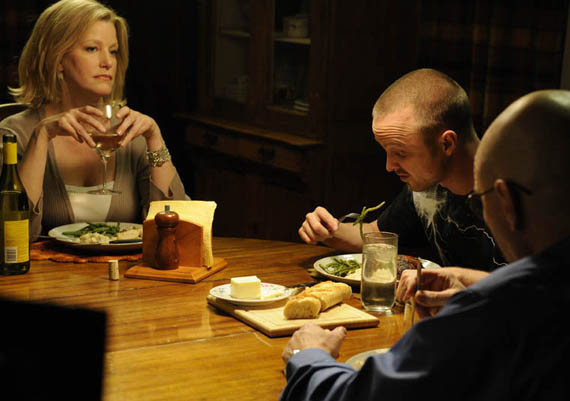
Jesse completely reverts to a juvenile state when he finds himself at Walt's home, and by weight of Walt's authority gets pressed into a dinner that he did not want to have with Skyler.  My favorite shot of the show is the 3-shot of them at the table, Jesse directly in the center trying to make light conversation about the beans, Skyler getting drunk and not touching her dinner, and Walt making his usual show of force, he not touching his dinner either.  It was a good comical moment.  But I just didn't buy it.  I believe it must have some future purpose, or character-deepening purpose.  I can see how the scene might simply drive the marriage plot deeper, the distance between them.  I can see how it might also feed the already billowed Walter ego.  I can even see how it advances Jesse's position further into the "son" role by having him there.  What I didn't agree with here (how I would have written it differently) was the level of Jesse's maturity not matching where he actually is in life, or in his knowledge of what he knows about "Mr. White".  He acted more like a Brandon Mayhew than the Jesse that came up with the brilliant idea of how to heist a train.

And Mike does not get bent out of shape and run into a room and point a gun at someone's head.  He's normally like the Mike that went to the house of one of the "boys" and hung a doll from the door knocker while he slipped around and into the back.  Out of character.  I thought it was kind of thrown at us that way to make the scene more tense, and a good way to end the episode.   Didn't buy this either.

Seeing as how the season has already been produced and shot and we're just waiting for the whole thing to unfold anyway,  the ending is inevitable.  I'm going to go bold now and say how I think this whole Shakespearian tragedy will unfold and end.  Jesse will kill Walt.  No, I'm not kidding.  He has to.  Jesse is his substitute son now, or the surrogate older brother for Flynn.  The love relationship between them is solid, until Jesse finds out all about everything that Walt has done.  I believe he will.  At every turn Walt has completely stabbed Jesse in the back, and gotten away with it.  But there are only so many times that a man can kill or nearly kill his best friends' friends, and it will come back to you.  Just ask MacBeth.

Jesse stands over and against Walt in so many ways, one wonders how many times they can be drawn back together and Walt still succeed in persuading him.  The lines were clearly drawn alright, as the blog http://calitreview.com/29597 points out.  Jesse could not have made it more clear.  "As I recall Mr. White, at one time all you needed was about 750,000, and it was for your son and your family.  Now what is it?  Why can't you be happy with 5 million?  What could possibly be wrong with 5 million dollars?"

Walt then proceeds to detail exactly why it's never really been just about the family, that faux excuse that has led him to confess that his real plight is a huge sense of underachievement, failure, which so many men cannot abide.

I have to say this: If the depth of the final verdict of this man, Mr. White, is not equivalent to the distance that he has travelled down the road of perdition, and the level of pain he has inflicted whilst blazing his head-long trail, then I will be among the disappointed.  Although I, for some odd reason, most likely as the rest of us, "love" Mr. White, somehow no matter what he has done, I will not confuse my sense of identity and emotional closeness with him with that of injustice or the need for closure in his case.  Something less than the chair, or the alternative of being all alone with his millions and not being able to spend them...or dead...may be an ending that the authors have in mind, but to me would be unsatisfactory.

Steven Marks

Monday, August 13, 2012


Breaking Bad

Season 5 Episode 5

"Dead Freight"

If you see some people around work today and ask them if they watched any TV last night, you may note that they may bow their heads, or look away, or shrug, or they may find some vague expletive to mumble.  They might also simply say, "Yep, did."  And then quietly walk away.  Some may even get teared up and stiffen their lips.  If you find this is true, then you're surely talking to people who watched last night's episode #5 of Breaking Bad's 5th season, named "Dead Freight".   All the others were watching the failed and sad Olympic closing ceremony with lame old rock stars and bad audio.  

There will be no spoilers here, which means basically I can't say much about this episode.  Besides which I was left speechless anyway.

I have watched this show season in and out, and know every nook and cranny of it, but not once did an episode make me completely break down and cry at the end.  I seriously asked myself if I could continue watching the show next week.  I'm sorry, I'll give that much away.  

Proceed with caution - not for the faint of heart.

I will say this on the other side of the coin, this was the episode I believe all fans were waiting to see this season.  I thought maybe the show was going to break down and become just so much suspenseful soap opera, and psychological drama.  Not true.  This week was action packed, and plenty of the old cinematic magic was back with tricky shots, and gutsy twists.  Nice job…but the ending…God help us.  Grandparents: adult children viewer discretion is a must.

Agitatus

Sunday, August 12, 2012


Breaking Bad 

Season 5 Episode 3
"Fifty-One"

Breaking Bad has taken us through some of the more twisted and torturous nights and days of the soul that televised productions have ever seen, and we come back for more, because the game is not ended.  MacBeth has not stabbed himself.  He is not yet muttering about being or not being, or talking to skulls.  Walter White is still babbling on over his terrified wife’s shoulder about how good life is, and about birthday parties, even after liquifying at least 2 adversarial relationships into a barrel, running over 2 other competitors, wasting an old man in a wheelchair whilst taking out his nemesis, watching and doing nothing as a girl who was sleeping drowns in her own vomit, gives the go ahead for the 2nd hand shooting of a partner who would not probably have hurt a flea and who made excellent coffee, and if that was not enough, harvested Lilly of the Valley, and not for the fragrance.

In all of the seasonal episodes, it’s been Brian Cranston who has gotten the credit.  However, in this season, I’m tempted to say the acting power on the screen is being equally shared.  Anna Gunn, who plays Walter’s wife, Skyler White, has swung the pendulum back the other way, and the emotional outburst in the last episode in their bedroom left me speechless.  It was a desperate plea, a known factor, yes, long expected, yet somehow Skyler White hits a note that was surprising as it was painful to hear.  It was like some kind of necessary evil that we knew was coming, yet it still hurts when it hit.  “Waiting for the cancer to return.”  This is a horrifying, yet expected statement, made at the end of a rope that has been unravelling now for 4 years (less than a year, TV time, we are reminded).
  
There is no way that I can now sympathize with the main character’s plight.  You always like Walter.  He is a great underdog, a real hard case with some kind of strange alchemy that keeps us rooting him on, even through the badness and temperature that we take of him is red hot and flaming with an overwhelming desire to win at all costs.  But now that the trail of tears is past, it would seem, and “life is good” is supposed to be the new normal, Walter putting his underwear back in his drawer, purchasing new cars for himself and his son, having DEA relative #1 over for the low-key birthday….now that all that seems to gloss over the rugged past, we see the reality breaking its way out from behind the curtain, and it comes via the wife, the morally troubled and helpless female half.  Great acting.  Oscar should be looking her way this year.

Friday, June 22, 2012


The New World       2005       Terrence Malick
I had believed for the longest time that The Last Emperor, Bertolucci's masterpiece from 1987, was quite possibly the most beautiful and lyrical film I had ever seen.  I have come to understand since then that although masterful, and beautiful in its own way, that film was cynical, or at best tainted with a kind of masochistic interest in destroying our perceptions of romanticism about the ancient world of ancestry and racial dominance.  His work also not so subtly raises the efficacy of the Red World of Communism at subduing the human desire to elevate the individual.
Well, now I have a new favorite film.  I can say without any reservation at all that The New World, Terrence Malick's own masterpiece of just a few years ago, 2005 release, is the most beautiful film I've ever seen, period.  It took me 4 viewings to really take it all in, it is so massive in scope.  When I say scope, however, do not be misled by the idea that somehow the simple story in history is what I'm referring to.  That can be told in a few short sentences to schoolchildren during a history lesson, and is all too true as well.   What I mean by scope is the reach of implications that lie under every wave of ocean footage, of flowing river eddy, in every dirt-buried fish scale, and look of the eyes of the natives as they stare into Lubezki's lens, taking their direction from Malick. 
The naturalism that embodies Malick's work is not that of Margaret Mead. It is sensitized by the Judeo-Christian view, yet also without pulling any punches at the harsh juxtaposition of the utterly confused, helpless, and deranged world of the white man as he struggles to come to grips in this new virgin territory.  The divine right of kings, privilege, society, order, industrialism, machinery, and superiority meet with the harsh reality of the untamed wild, Virginia. Without any words at all of sanctimonious histrionic claptrap woven into the script, Malick manages to challenge, without reservation, the calamity of the white man's invasion, religious justifications and all.  If you can view this film without a sense of loss, without a sense of questioning of your own life and place in this earth, then go rent a Disney flick at a Redbox.
But it is much more than that as well.  Interwoven is the complex web of desire, fulfillment, longing, romance if you will, and difficulty of the human love story, and how the working out of those relationships are laid siege to over and against the backdrop of forces and purposes allied against it.  There is a true love story going on here that has everything to do with fidelity and truth, and laying bare of the intentions of man, and how that mirrors the events themselves.  Masterful writing.  Absolutely masterful.  And here I was thinking that the basic children's story was enough in its naiveté.
I'd like to say more, but it's late and I'm really tired and must get this down while it's fresh.  No other film has touched this subject with the same kind of honesty and sensitivity, but mostly beauty and artistic perfection.  I own the BluRay copy, and will doubtless see it again a few more times, while attempting to share it with others.
More than 5 stars.

Sunday, June 10, 2012


The Lovely Bones - 2009
Peter Jackson (CrazyHeart, Avatar)
Saoirse Ronan
Rachel Weisz


I will never be like that man.

Those are the words that came to my mind after viewing this.  Because that man and myself are about as far apart as the poles, and as far as east from west. 

God has blessed me with the gift of grace, and goodness, and a heart that loves that which is lovely, and I could no more hurt one of these little ones than I could take out my own heart and watch it beat.

The lovely bones stare back at us from this work, of all those that have cried from the grave against their murderers, and I’m sure they will suffer more than a little tumble over a cliff.

I don’t think there was one misplaced emotion in this film.  It is a recollection piece, of hope mostly, for those that have lost a child, or a young loved one, especially a lost young one that would never be recovered, and most without ever having the satisfaction of finding out who had done it in the end, the strange neighbor, the best friend of the family that moved away one day without warning, the butler, the janitor, the Senator, the lover…

The special effects only augmented the sense of this story, and did not overcrowd it.  The human element was preserved and not overshadowed by the visions of heaven.  You must really appreciate Peter Jackson for this.  They were in fact stupendous, well done, well placed.  And they were numerous, almost a third of the film or more.  But yet they never overshadowed the reality of the family that lay at the center of the tragedy, the stages of relational stress that the couple went through, the resentment, then the abandonment, the loss of love and innocence.  The stress and strain in relations was abrupt, appropriate, realistic, and finally, relieved in the center by the invited relative, Mother-In-Law-In-Charge.  Susan Sarandon was flawless as the bewitching, hapless, crisis caretaker Mother, who in the end also changes, it would seem to be much, much more stable, enduring, and responsible than you would guess.  Oh, and comedy relief, much needed in this tragedy.

It was all there, played out very nicely for us with cinematic bravado.  And it was also not preachy, or religiously offensive.  It leaves room in the end for belief and truth in the end, without excluding anyone, except the hardened atheist perhaps.   Hope seems to be a great hallmark of Peter’s films, the Lord of the Rings being a good example of the very same, the Grey Havens not only in Tolkein’s mind, but realized in the film version as well.  This is not just fluff, or aspirin for the wounded soul.  It’s a real hope built on the idea that love and relationships, especially between a father and a daughter, can reach back even from the grave and make things right again.

The power of the bond of human relations is upheld by this film, and I strongly recommend it for everyone who is old enough to deal with images and the characterization of the reality of death, and especially gruesome types of death and the threat of death at the hands of a villainous creature like the neighbor.  So I’d say 18 or older could understand this, if properly prepared.  It’s heart-wrenching stuff, and not for the emotionally immature however, or the innocent among us, for it presents themes which if seen much too early, could cause fear, instead of comfort, and maybe even fear of the normal neighbor.  I like the fact that we started with a normal neighbor as suspicious and we find out quickly that he was only a bit odd, but loved his daughter, who died of Leukemia.  This took some of the edge off right away, while still suspending the mystery.  I also love the fact that it was not “all about the bad man”.  It was about the love relationship between the parent, and the lost one, and the results of the family, and not just a sagging drama about the horrors of a serial killer.  Yes, the facts were all there, but they were bound up in the narration and discovery journey of the main character.  The plot of the killer and his heinous trail is only revealed as Susie Salmon is ready to receive it.

Great stuff, both the writing, and the cinema.

Friday, June 01, 2012

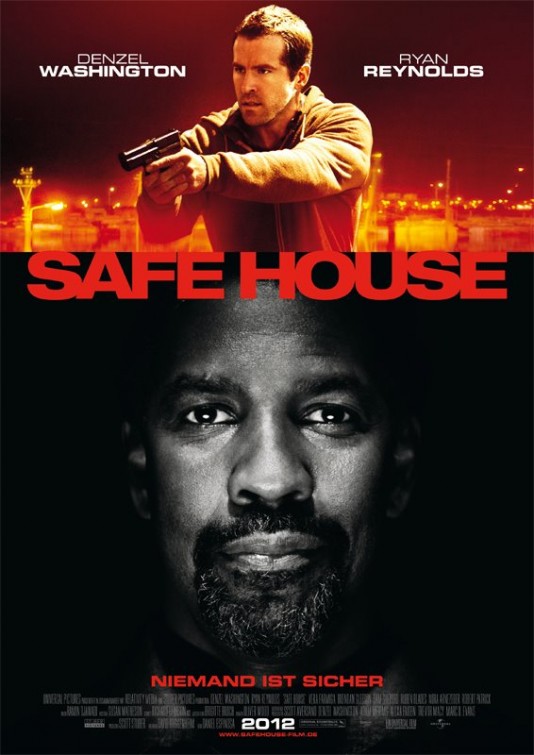
Safe House - 2012 Review Part B (please note letter of alphabet and see the previous review 1st before reading this one)

ok wait.....

The real scoop.  What I just published was true.  It's a taut thriller, sure, but with predictable re-runs of plot.  Great acting as usual, yes.  Tense scenes that you like to watch because they are...well...tense, and I'm an adrenaline junkie when it comes to tense films.

But honestly, the story hinges on a (person - don't want to spoil it for you here) inside the CIA that has stuff to hide.  Ok, been there, done that.  Went to great extent to hide the crud.  And Denzel went to a great extent too!...in his butt no less (no, it's not what you think).

So ok, this is really exciting to watch.  I almost said "fun" but that's "fun" as in thrill ride, not as in "happy".  This film joins the Borne Identity trilogy, but as a one-off, and no way for a sequel.  Nothing more to discover.  Bad guy dies.  End of trail.  Also, girl beautiful adds human interest and motive, depth, though only surface, to Reynolds' character.  Borne was kind of like that, until she died in that film.  After that, it was revenge.

The allusion to a Wiki-Leaks kind of ending is interesting, and up to date, sure, giving some indication that the producer is information "open-source".  So there is this pseudo-satisfaction kind of conclusion I suppose, but weak, considering the body count.  One of the main characters does get to "explain" that to us near the end, a justification for hiding the trail of tears (about 300 documents worth lots of supposed cash that I did not understand who was purchasing the entire time the plot was thickening).

Summary: lots of action, fast, blood, thrill...nolo contend-re on substance.  
Safe House - 2012 - Denzel Washington, Ryan Reynolds, Vera Farminga, Benden Gleeson, Sam Shepard

Messy.  Very messy.

Taut.  Tense.  Let's see....uh, same kind of tension as Borne Identity, only more sustained, and more bloodshed, and....well, more bloodshed actually.  Lots of close-up action and psychological tension, and cool Mr. Washington, as usual somehow cool even when he's dying.

Oh, and the CIA is bad, a brand new revelation that has NEVER been said in motion pictures before!  Wow!  I can't believe they were even able to make this picture without getting shut down by the government for treason or something!  I mean, please!  I can't believe that I've seen this!  Wow!  I was looking over my shoulder as I left the theatre because I thought for sure that black ops was going to go all gangsta on us outside the theatre and pull us in for Nterrogation and such.  Man.  I am still scared!  Ah!  If you rent this.....well....change your phone number and your IP address or something because you could get your internet cut off, and a bad credit report, and...and...who knows what else!

Thursday, May 03, 2012


American Pastoral by Phillip Roth
My rating: 5 of 5 stars

Contrast.  I could simply end my review of this novel with that one word.  It’s the old guard V the new, the old world and American idealism clashes with the reality of an intrusive cultural upheaval in the 60s.

What incredibly woven prose.  This is a character-driven plot, but the characters are so vivid, so thick, real, it has real page-turner potential, while the actual plot itself I could easily outline in only a paragraph or two.  This is quintessential roth style, in other words, drag out the character analysis until we know them better than they know themselves.

The complexity that visits us here in these pages is the depths of the human condition, under stress, under change, under the demand of a new assertive communism tossing the proverbial wet blanket on the free American capitalist dream.

There are historical plot points aplenty, and much to learn about the making of capital, the love of industry, the honesty of toil and creating the atmosphere of work and survival, even over and against change.  Oh, and the glove business.  The dismantling of the system is seen as inevitable in so many other ways, except for this stalwart being known as “The Swede”, a blonde Jewish athletic hero, yes very unlikely as that sounds, married to the Goy princess of New Jersey who has to make a bargain with the father-in-law for how much Christianity she will openly allow in their house, if they are wed.
  
I wanted to accuse Mr. Roth of authorial intrusion at one point when he so open handedly slapped us with a three-line sentence that summed up the communist manifesto’s rage against capitalism, at first impression seeming that it was Mr. Roth’s point of view.  But as it turns out, I believe that jarring juxtaposition was a simple foreshadowing of the daughter’s revolutionary character, which we find is very true later on.

Contrast is what this story is all about.  A great and sweeping novel of history and personal change with the characters as solid metaphors for the times they lived.  The prose borders on insanity at times, only to slap us with the reality of the world in that day.
  
This should be on one of those “must read” lists.
5 stars out of 5.
Please reference for details: