Search This Blog

Friday, June 22, 2012


The New World       2005       Terrence Malick
I had believed for the longest time that The Last Emperor, Bertolucci's masterpiece from 1987, was quite possibly the most beautiful and lyrical film I had ever seen.  I have come to understand since then that although masterful, and beautiful in its own way, that film was cynical, or at best tainted with a kind of masochistic interest in destroying our perceptions of romanticism about the ancient world of ancestry and racial dominance.  His work also not so subtly raises the efficacy of the Red World of Communism at subduing the human desire to elevate the individual.
Well, now I have a new favorite film.  I can say without any reservation at all that The New World, Terrence Malick's own masterpiece of just a few years ago, 2005 release, is the most beautiful film I've ever seen, period.  It took me 4 viewings to really take it all in, it is so massive in scope.  When I say scope, however, do not be misled by the idea that somehow the simple story in history is what I'm referring to.  That can be told in a few short sentences to schoolchildren during a history lesson, and is all too true as well.   What I mean by scope is the reach of implications that lie under every wave of ocean footage, of flowing river eddy, in every dirt-buried fish scale, and look of the eyes of the natives as they stare into Lubezki's lens, taking their direction from Malick. 
The naturalism that embodies Malick's work is not that of Margaret Mead. It is sensitized by the Judeo-Christian view, yet also without pulling any punches at the harsh juxtaposition of the utterly confused, helpless, and deranged world of the white man as he struggles to come to grips in this new virgin territory.  The divine right of kings, privilege, society, order, industrialism, machinery, and superiority meet with the harsh reality of the untamed wild, Virginia. Without any words at all of sanctimonious histrionic claptrap woven into the script, Malick manages to challenge, without reservation, the calamity of the white man's invasion, religious justifications and all.  If you can view this film without a sense of loss, without a sense of questioning of your own life and place in this earth, then go rent a Disney flick at a Redbox.
But it is much more than that as well.  Interwoven is the complex web of desire, fulfillment, longing, romance if you will, and difficulty of the human love story, and how the working out of those relationships are laid siege to over and against the backdrop of forces and purposes allied against it.  There is a true love story going on here that has everything to do with fidelity and truth, and laying bare of the intentions of man, and how that mirrors the events themselves.  Masterful writing.  Absolutely masterful.  And here I was thinking that the basic children's story was enough in its naiveté.
I'd like to say more, but it's late and I'm really tired and must get this down while it's fresh.  No other film has touched this subject with the same kind of honesty and sensitivity, but mostly beauty and artistic perfection.  I own the BluRay copy, and will doubtless see it again a few more times, while attempting to share it with others.
More than 5 stars.

Sunday, June 10, 2012


The Lovely Bones - 2009
Peter Jackson (CrazyHeart, Avatar)
Saoirse Ronan
Rachel Weisz


I will never be like that man.

Those are the words that came to my mind after viewing this.  Because that man and myself are about as far apart as the poles, and as far as east from west. 

God has blessed me with the gift of grace, and goodness, and a heart that loves that which is lovely, and I could no more hurt one of these little ones than I could take out my own heart and watch it beat.

The lovely bones stare back at us from this work, of all those that have cried from the grave against their murderers, and I’m sure they will suffer more than a little tumble over a cliff.

I don’t think there was one misplaced emotion in this film.  It is a recollection piece, of hope mostly, for those that have lost a child, or a young loved one, especially a lost young one that would never be recovered, and most without ever having the satisfaction of finding out who had done it in the end, the strange neighbor, the best friend of the family that moved away one day without warning, the butler, the janitor, the Senator, the lover…

The special effects only augmented the sense of this story, and did not overcrowd it.  The human element was preserved and not overshadowed by the visions of heaven.  You must really appreciate Peter Jackson for this.  They were in fact stupendous, well done, well placed.  And they were numerous, almost a third of the film or more.  But yet they never overshadowed the reality of the family that lay at the center of the tragedy, the stages of relational stress that the couple went through, the resentment, then the abandonment, the loss of love and innocence.  The stress and strain in relations was abrupt, appropriate, realistic, and finally, relieved in the center by the invited relative, Mother-In-Law-In-Charge.  Susan Sarandon was flawless as the bewitching, hapless, crisis caretaker Mother, who in the end also changes, it would seem to be much, much more stable, enduring, and responsible than you would guess.  Oh, and comedy relief, much needed in this tragedy.

It was all there, played out very nicely for us with cinematic bravado.  And it was also not preachy, or religiously offensive.  It leaves room in the end for belief and truth in the end, without excluding anyone, except the hardened atheist perhaps.   Hope seems to be a great hallmark of Peter’s films, the Lord of the Rings being a good example of the very same, the Grey Havens not only in Tolkein’s mind, but realized in the film version as well.  This is not just fluff, or aspirin for the wounded soul.  It’s a real hope built on the idea that love and relationships, especially between a father and a daughter, can reach back even from the grave and make things right again.

The power of the bond of human relations is upheld by this film, and I strongly recommend it for everyone who is old enough to deal with images and the characterization of the reality of death, and especially gruesome types of death and the threat of death at the hands of a villainous creature like the neighbor.  So I’d say 18 or older could understand this, if properly prepared.  It’s heart-wrenching stuff, and not for the emotionally immature however, or the innocent among us, for it presents themes which if seen much too early, could cause fear, instead of comfort, and maybe even fear of the normal neighbor.  I like the fact that we started with a normal neighbor as suspicious and we find out quickly that he was only a bit odd, but loved his daughter, who died of Leukemia.  This took some of the edge off right away, while still suspending the mystery.  I also love the fact that it was not “all about the bad man”.  It was about the love relationship between the parent, and the lost one, and the results of the family, and not just a sagging drama about the horrors of a serial killer.  Yes, the facts were all there, but they were bound up in the narration and discovery journey of the main character.  The plot of the killer and his heinous trail is only revealed as Susie Salmon is ready to receive it.

Great stuff, both the writing, and the cinema.

Friday, June 01, 2012

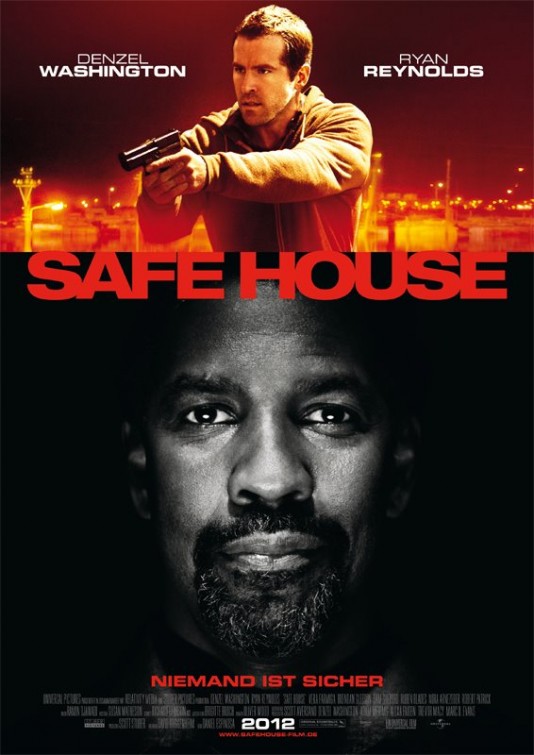
Safe House - 2012 Review Part B (please note letter of alphabet and see the previous review 1st before reading this one)

ok wait.....

The real scoop.  What I just published was true.  It's a taut thriller, sure, but with predictable re-runs of plot.  Great acting as usual, yes.  Tense scenes that you like to watch because they are...well...tense, and I'm an adrenaline junkie when it comes to tense films.

But honestly, the story hinges on a (person - don't want to spoil it for you here) inside the CIA that has stuff to hide.  Ok, been there, done that.  Went to great extent to hide the crud.  And Denzel went to a great extent too!...in his butt no less (no, it's not what you think).

So ok, this is really exciting to watch.  I almost said "fun" but that's "fun" as in thrill ride, not as in "happy".  This film joins the Borne Identity trilogy, but as a one-off, and no way for a sequel.  Nothing more to discover.  Bad guy dies.  End of trail.  Also, girl beautiful adds human interest and motive, depth, though only surface, to Reynolds' character.  Borne was kind of like that, until she died in that film.  After that, it was revenge.

The allusion to a Wiki-Leaks kind of ending is interesting, and up to date, sure, giving some indication that the producer is information "open-source".  So there is this pseudo-satisfaction kind of conclusion I suppose, but weak, considering the body count.  One of the main characters does get to "explain" that to us near the end, a justification for hiding the trail of tears (about 300 documents worth lots of supposed cash that I did not understand who was purchasing the entire time the plot was thickening).

Summary: lots of action, fast, blood, thrill...nolo contend-re on substance.  
Safe House - 2012 - Denzel Washington, Ryan Reynolds, Vera Farminga, Benden Gleeson, Sam Shepard

Messy.  Very messy.

Taut.  Tense.  Let's see....uh, same kind of tension as Borne Identity, only more sustained, and more bloodshed, and....well, more bloodshed actually.  Lots of close-up action and psychological tension, and cool Mr. Washington, as usual somehow cool even when he's dying.

Oh, and the CIA is bad, a brand new revelation that has NEVER been said in motion pictures before!  Wow!  I can't believe they were even able to make this picture without getting shut down by the government for treason or something!  I mean, please!  I can't believe that I've seen this!  Wow!  I was looking over my shoulder as I left the theatre because I thought for sure that black ops was going to go all gangsta on us outside the theatre and pull us in for Nterrogation and such.  Man.  I am still scared!  Ah!  If you rent this.....well....change your phone number and your IP address or something because you could get your internet cut off, and a bad credit report, and...and...who knows what else!

Thursday, May 03, 2012


American Pastoral by Phillip Roth
My rating: 5 of 5 stars

Contrast.  I could simply end my review of this novel with that one word.  It’s the old guard V the new, the old world and American idealism clashes with the reality of an intrusive cultural upheaval in the 60s.

What incredibly woven prose.  This is a character-driven plot, but the characters are so vivid, so thick, real, it has real page-turner potential, while the actual plot itself I could easily outline in only a paragraph or two.  This is quintessential roth style, in other words, drag out the character analysis until we know them better than they know themselves.

The complexity that visits us here in these pages is the depths of the human condition, under stress, under change, under the demand of a new assertive communism tossing the proverbial wet blanket on the free American capitalist dream.

There are historical plot points aplenty, and much to learn about the making of capital, the love of industry, the honesty of toil and creating the atmosphere of work and survival, even over and against change.  Oh, and the glove business.  The dismantling of the system is seen as inevitable in so many other ways, except for this stalwart being known as “The Swede”, a blonde Jewish athletic hero, yes very unlikely as that sounds, married to the Goy princess of New Jersey who has to make a bargain with the father-in-law for how much Christianity she will openly allow in their house, if they are wed.
  
I wanted to accuse Mr. Roth of authorial intrusion at one point when he so open handedly slapped us with a three-line sentence that summed up the communist manifesto’s rage against capitalism, at first impression seeming that it was Mr. Roth’s point of view.  But as it turns out, I believe that jarring juxtaposition was a simple foreshadowing of the daughter’s revolutionary character, which we find is very true later on.

Contrast is what this story is all about.  A great and sweeping novel of history and personal change with the characters as solid metaphors for the times they lived.  The prose borders on insanity at times, only to slap us with the reality of the world in that day.
  
This should be on one of those “must read” lists.
5 stars out of 5.
Please reference for details:

Sunday, April 29, 2012


MiddlesexMiddlesex by Jeffrey Eugenides
My rating: 5 of 5 stars

Tremendous, sweeping, elegant, jarring, yet so engrossing as well.  Did not want to leave the text the whole time.  This is an EPIC, yet also deeply personal.  In much the way Tolstoy handled the sweep of history by creating personal characters and making them EMBODY the history, so Jeffrey places equal value on character development and involvement, with that of historical insight.  Powerful book, and one I'm not soon to forget.

The first part of the book, while in Eugenides style of "shock and awe" he discloses to us his intentions to a great degree, and reveals the "end" as it were of the gut of the book, is mainly history and backstory, it is nonetheless essential and never leaves us gasping for the narrator to "get to the point".  He keeps it interesting and engaging, always returning to the current situation of the narrator in order to hook us in.  And the narrator in this case is the main character of the novel, so therefore, we are being witness to what feels like a first person account of the life and times, and origins, of something we hardly ever think about, let alone encounter, a true Hermaphrodite; the sexual organs of both female and male in a strange mix that is so genetically rare.  And we encounter how just such a thing can happen genetically, and personally, via the family history that brings it about.

This book is just too good to pass up, and is a must read.  There is a reason that the Pulitzer was placed on this book, having both historical implications and accuracy, but also personal and social understanding that is not just revealing, but also relevant to the climate of universal human understanding that we find ourselves in today, the 21st Century that looks back on history with fresh eyes.

Get it.


View all my reviews

Monday, March 05, 2012

The Virgin Suicides
Jeffrey Eugenides
1993 - Picador, NY

Much has already been written about this book.  I will write some more, since I just finished it yesterday.  I also plan on now reading Middlesex, and The Marriage Plot, all of which I just purchased, all of which I just discovered, because I am in a time warp of unfathomable dimensions and never seem to catch up culturally, with anything.

We love this book because it is like the scenes on the news where we weep with victims and put our flowers out on the sidewalks and shrines around their houses, and hold candlelight vigils and sing slow and mumbled, careful songs in groups together, cathartic and removed; otherworldly.

This is the sense with which Eugenides catches us off guard at every turn, first taking us in with realism and familiarity, and then as the plot thickens, totally waking us to a new reality.  The most stunning line in the book that I can recall is in the first part when he is describing the beauty and grace of the girls, and how beautiful and underrated the necks of females are with regards to their erotic power.  We're all aswoon with his beatific vision of the snowy erotic neck when he then ends the sentence with a rope around that flesh.  Pow.  Ow.  I've just been bushwhacked from nowhere by prose.  Elegant.  Jarring.  Fantastic.

I can see from the Google Images pages after finding the image for this book cover, that young girls especially are "fans" of this work across the spectrum, most likely idealizing the subjects of the book in the way that fans of rock stars place posters on their walls.  Yet young men would also find voice in this text, for in it are the associations most universal with all testosterone and early hormonal-laden infatuations and forays into the world of the female.  This book so perfectly echoes the voice of the young American male of the late 60s and 70s, in that period language, but also hits a note of teenage innocence and desire that is timeless.

I am a perennial lover of Frederick Buechner, Flannery O'Connor, Tolstoy, Kerouac, and other luminaries, but Jeff has now been added to my list of authors that can absolutely astound.  The aliterations and metaphors that are like a barrage of night-sky meteors frequented throughout the book, yet also planned so carefully as to be deceptively natural, have challenged me as a budding writer to aspire to this level of thinking about story.

Such as his description of time passing by.  He states, and I am not quoting here, I am only writing from memory, because the memory is that strong it is so well done, "We only noted the passing of time during the days by the way our mouths tasted at various points along the way, all tooth-pasty in the morning, and like leftover bologna in the afternoon".  "Like tongue film...." is another reference.  Brilliant.

And I have not even read his Pulitzer Prize next novel "Middlesex".  The hardcover edition, from Amazon, is sitting here staring at me now with its deceptively bland "JE" embossed in the cover (I always take the jackets off of books to read them, so they don't get all messed up).

So I shall talk with you all after that edition is done, and report what I find.  Thanks again for tuning in.

Agitatus

Wednesday, February 15, 2012

Open City - a novel
Teju Cole
my part 2

please read my part 1 from Saturday Feb. 4th

My sense is that Teju is mining underneath for that which is not visible, is not readable for the average and non-attentive eye.  Mr. Cole does not tell, he shows.  This is most excellent writing, and consistent.  He has an agenda, but it is never what you think it is on the surface.  He has this surprising way of using the assets of his life and the world around and uncovering it then in the numinous.

He subtly forces his hand at the last, with an almost cryptic metaphor, but in the second breath that one takes upon finishing the book this way, you realize that it was perfectly executed as a summary; not one you expect, yet a summary of the contents that only an artist could conjure.

Bravo Mr. Cole.  Please don't stay only in art studies, but do please write again.  Will be waiting for another book.

I repeat here the link to his interview on the PBS site: http://tinyurl.com/72ph73f

Agitatus

Sunday, February 12, 2012

Forthcoming:
Raw excerpts from a brand new novel
by my good friend
                    Stephen Marks
The Amish Vampire of Pennsylvania


Get on my mailing list: write to agitatus@gmail.com

Saturday, February 11, 2012

Update: Hey you readers from Canada to India, I have not lived up to my promise to write about all the other films I've seen.   Not yet.  Circumstances have been taking my time.
I'll try to get to them as soon as I can.
If you'd like to be on my mailing list, please write "Yes" to me at the following address:

agitatus@gmail.com

I will only write to you if I post a review, and will not spam you.  I will respect your privacy.

Thanks again for reading.

Agitatus
War Horse                                                              2011 Stephen Spielberg

Not your usual Spielberg type of topic, a straightforward narrative of history, much like Schindler's List in the ambition to capture the scope of the day's drama, yet also Disney-like in it's mechanism, War Horse takes us within a human drama of innocence lost, loyalty found, and sacrifice.

The story is great.  The thread of the narrative deserves a prize for its ingenuity and originality.  I was only taken back a bit by the obvious way in which many scenes played out, such as when horse and rider are united in the recovery camp in France.  Another thing that was missing was a link between England and the European continent.  I would think that one small scene of the horse on a boat with other horses could have filled that gap for us a bit, but there was none.  The youthful viewer who is not a keeper of historic understanding might believe that the war was just next door from England.

But the drama was good.  The acting was fine.  This was an "ok" movie for youth to see, and would be inspiring.  Much like his film "8mm", the film itself was a bit juvenile, and I suspect that Spielberg, for all his magic moments, has never really grown beyond ET to some degree.  He is forever enthralled with a youthful type of view.  Yet this does not diminish the parts of his films that appeal to the adult, and seriously deal with those topics we avoid, yet love to hate.

(spoiler here) The most poignant moment, most would agree, would be the meeting of the Allied soldier and the German soldier in the center of the battlefield, in order to free the horse.  It was funny, fascinating, sad, and melancholy all at once.  I was reminded of the moment in WWI when on Christmas Eve all fighting purposefully was called to a halt and the soldiers all came out of their trenches to smoke, talk, and share a moment of peace together before continuing the war the next day.  This really happened in history, and these kinds of moments continue to be the hallmark of Spielberg work.

Out of 10, this film must get a 6.5 for delivery, yet an 8.5 for the writing.  Good story.

Saturday, February 04, 2012

Open City - a novel
Teju Cole

The ending of some chapters are cryptic and seem disconnected with the paragraph that ends each text.  It is a leading, yet also a pervasive style of Cole’s that he continually prods us on with mystical enumerations and almost prodigal ideas that at once seem disjointed, yet then come together at some point.  When they do collide, they are powerful and leave quite the impression.  He is leading us to a place of openness, that is true, but an understanding that the world is not exactly set in stone.

His mention of the “open city” was one of contrition by the Belgium people, that when they were attacked by the Nazis, they declared their city Brussels an “Open City”, meaning that there was no need to attack or destroy, but in a contrite way would provide open access to whatever the new German regime needed.  The city was then spared of atrocities and physical destruction, and many old world edifices and architecture remained.

Attempting to make sense of the complex world of Europe, Arab, Palestine, Jew, and the American view of it all, Cole deftly handles political positions and opinions by portraying great characters that embody those different worlds, and hands over treatment of their various viewpoints in graphic and rhetorical ways that undeniably make sense of it, without being preachy or heavyhanded.  His use of the experiential viewpoint of the Doctor in the story creates a wonderful platform for petri-dishing the various universes he encounters.  Yet at the same time the central character of Julius has his own definitive view, and does not simply buffer what everyone says to him and hold these opinions as blameless and dispassionate.  Rather, he fairly dissects the arguments and the dispositions that he encounters with grace, yet with disagreement at time, including his own dissection of art.  The fairness of Julius is never in question, and I have quite the great estimation of him half way through the book.  But I’ve only read half, so I’ll write again on this after I finish.
   
So far, as a fellow writer, I am astonished that Cole has been able to sustain my attention, and as intense an interest in the work, with as little action or plot or even relationships that he has developed in the story.  If one was to look at the outward plotting of the book in a linear fashion: doctor lives in the city, feels the need to take a visit to find his mother in Brussels, encounters friends of differing persuasions there, admires art work along the way: this would read in a very dull fashion indeed.  But it is anything but dull.  His insights so far into the soul of culture are worth the visit to this text alone.  More later.

Picture credit and link to PBS website with an interview with Mr. Cole: http://tinyurl.com/72ph73f

Wednesday, January 11, 2012

Another PS: Thank you for reading my blog to the person/s in Edinburg-Scotland, Council Bluffs-Iowa, Drummondville-Quebec, Brussels-Belgium, Indianapolis-Indiana, and Berlin-Wisconsin, to name a few.  Blessings to you.

Agitatus
As an aside, the University here is playing The Tree of Life (no, not the book store), next Tuesday night, coincidentally the day of the start of our media fast.  Hmm, maybe I'll take my oldest, as this is the last movie she would see for 6 weeks?  I've already seen it 4 times, 2wice at the theatre.  In any case, yes, Tuesday night, Tree of Life, and then on THURSDAY night they will have a discussion panel of faculty about the film.  Will probably not miss that, as it is not media necessarily, and consists of an educational experience, one which I"m sure to weigh in as a participant.
Ah, the Year of our Lord and Savior Jesus the Christ 2012 (if indeed that is really how long it's been since his actual death and resurrection because we all know the calendar is off from its origins).

But it is the year and year beginning that we've named 2012, which would be 2 thousand and twelve years after the event.  The Jewish calendar is much more in number than ours, today being the 16th of Tevet, 5772, which actually means 5 thousand seven hundred and seventy two years since creation, or thereabouts since the finishing of the last day of creation, the Shabbat, or the day of rest.  Interesting stuff.


So, there comes a time in every movie-lovers life that they must indeed take a rest from film.  Yes.  My family no longer functions without media involvement, so now is that time.  On Jan 17th, next Tuesday in fact, 2012, we will be "pulling the plug" on everything except the major sports events like the playoffs and super bowl, and the news.  6 weeks.  Yes, 6 weeks without media input.  We can play music while we are doing a task, meditative while writing or resting, and other selections of pop, rock, or jazz, whatever, while physically working.  Nighttime audio stories will be allowed, or podcasts as long as they are of a literary or educational nature.  But as far as VISUAL media is concerned, it's a no-no.  No cartoons, no movies, no TV, nada, zilch.

So in the meantime, prior to this media fast, we celebrated the end of our movie season by going to see film at the theatre, and also Netflix.  By the way, the reason for the start date of our voluntary media deprivation is because I'm canceling Netflix for good on the 16th, which is the last day of the billing cycle.  Bye bye.  From the 17th through Feb. 28th.  Yes, I know it's leap year.  I've left that date open in case we actually want to go to a movie.

So this means I'd better write some good reviews of the films I've seen since the end of the writing of my last novel, which would be Dec. 1st until the present, and that includes :

War Horse
The Philosopher Kings
True Grit
Twilight Zone Season 1, Ep. 4: The 16 mm Shrine
Gnomeo and Juliet
A Christmas Carol (Carrey - animated)
The Accused
Mission Impossible: Ghost Protocol
Bronson
Absolute Power
Life in a Day
Fear
Leaves of Grass

Believe it or not, yes, all of that, and probably a few more that I'm not going to rate because they stanketh, and I don't want them even mentioned in my blog.  That's the price of media criticism, you have to eat some turkey burger on your way to the steak.

But wait, some of that stuff is REALLLY old, man.  Why do you wait to write about it now?

Well, I haven't SEEN it until now, and I believe there is no time like the present to comment on something that is fresh in the mind.  I don't care if it's OLD or not, they still write about Citizen Kane don't they?

Ok, see you in my next reviews, which I will try to summarize over the next few days (along with anything else I happen to see between now and the, uh...17th).

Wednesday, November 30, 2011

I did it! ! !

As you can see by my widgets below, I got past the 50K word mark today.  In fact, I was ahead, and only had to write about 350 words today, so today was easy.  Actually, the whole thing was not that hard!  So here's my web badge of honor.

And then comes December....yeah, and January.  What are those you ask?  REVISION!

Wednesday, November 23, 2011

Writing a novel this Month with NaNoWriMo.  National Novel Writing Month.  Yes, and I'm keeping pace with what they call a novel.  Currently on day 23, I'm at 38,235 words, so a bit ahead at the moment.  I've been on or above par most of the time.  This means I should top the score of 50,000 words on or before Nov. 30th.   
Novel's title: The Amish Vampire of Pennsylvania
Yes, you've heard it here first.  Here is my "word count widget" to show my progress.


Wednesday, November 09, 2011

Melancholia
2011 Lars Von Trier

Von Trier has managed to place us in the unenviable position as an audience in the first-person witness to the end of the world, and, as REM stated in the 80s angst of that time, "and I feel fine".  Indeed we do seem to feel fine as the end of the world comes, and somehow, although sad as it may seem, we in some strange way identify with Justine, played masterfully melancholy by Kirsten Dundst, and are sensing the need to hush the worried Claire, played by the trepidatious antics of Charlotte Gainsborough. 
The 2-part play, which is intended as a dichotomy of psychological space between 2 differing views of the world, indeed is executed with pinpoint accuracy and distance between the two parties, libertarian and conservative.
One of the most annoying lines of the story is from Keifer Sutherland.  "How many holes does our golf course have?"
The sheer beauty of the opening prologue of the film in extreme slow motion is in itself an answer to that question, which if the artist were here with me on the page, he may say in effect the following:
"Who in their right mind gives a (*&^"
The opening of the film is a short film in and of itself that needs no afterword or narrative function to follow.  As a piece of art it could stand alone.
Worth seeing, most definitely yes.  Jumping to agree with in its conclusions: not on same page.  But a beautiful piece of art and directing, nonetheless.

Agitatus

Wednesday, September 07, 2011

Hermanos - Installment 8, Season 5 of Breaking Bad

Just how deep does the Meth rabbit-hole go?  We get a taste in this week's Breaking Bad.  Roots that go back to other times, and other countries, like Chile, begin to unravel for us. 

The writing is still fresh and brilliant, and I am continually amazed at the complexity, yet the solidity of the story that is unfolding in Breaking Bad, now in the 4th season.  The characters in BB are none of them flat, or uninteresting.  Every one has a crucial role.  The writing deserves the Oscar, and the execution via camera work, sets, lighting, locations, and acting, somehow have mixed here to make a cinematic alchemy, a metaphysical work of wonder.   Needless to say, I'm a fan, and I have never seen anything like it.

The one thing that always worries me about something like this, is the end.  And now, for some strange reason, it appears that I don't have to worry about that for yet another season.  BB has been approved for Season 5, so I take it we're going to have "more to come".

Saturday, January 29, 2011

Although I saw this at the theatre (my family was gone and I had little else to keep me occupied), this would make a good rental, as I reserve most of my theatre viewing for films that have some artistic or cinematic merit and deserve to be seen on the large screen.  RED (Retired and Extremely Dangerous) was very funny.  I liked it and would see it again (as a rental as I said).  It was a blast not only to see Bruce Willis looking actually old for once, but all of the other old farts shooting and getting their teenage-ninja thing on against the CIA staff and other likely bad people, with the old hero twist in there as a self-sacrificing Morgan Freeman.  The beginning is astonishingly high-impact and jettisons us into the plot, and the story worth following as well.  The very comical and ever blustering John Malkovitch in this role was easy for him it would seem, and having him play the mad scientist look-alike and fall guy was great.  Mary-Louise Parker was personable and stood out against Bruce Willis with her own style, reminiscent of 12 Monkeys.

Over all I liked RED because it was always moving and didn’t disappoint with filler material.  The end twist made the story wrap up nice and was not cheesy.

Overall about 3.5 stars for entertainment value and about 2.5 stars for the scripting.  There were no memorable quotes or outstanding written moments to speak of.  Just fun.

Sunday, January 16, 2011

Devil - 2010 - John Erick Dowdle directs.   Stars: Chris Messina, Caroline Dhavernas and Bokeem Woodbine.

There’s nothing quite like South American Folklore mixed with modern, inner-city dimness and angst, and blended together in a 5 x 6 x 8 room that moves quickly up and down a shaft, then gets stuck with 5 people in it, one of whom is the Devil.  Nothing quite like the latest Shayamalan installation in his continuing odyssey of shock and awe, and the surprise ending.  He didn’t direct Devil, John Erick Dowdle did.   But it “came from his mind”, as the advertisement tells us.

I understand that this got laughs at a preview of a sophisticated audience.  Just goes to show you what sophistication does for you, jade and censure.  However, I did find that this installment in what appears to be the first of a “Night Chronicles” was somewhat lackluster in its general effects, yet it still has suspense and appeal.  It definitely had a linear storyline and a speed and direction.  It had all the elements that he usually has, this time with multiple protagonists and the surprise.  It was a surprise at the end not so much for who the Devil was, but because the person of the Devil was so cliche, or abrupt, or “normal”.  I guess it’s what we’ve come to expect, with the multi-phased voice, the black eyes, and such.  Well, it’s still worth seeing if you’re a M. Night fan.  This film definitely had the element of the “teaser”, as did “Lady in the Water”.  Threads of the story are given to us piecemeal as we go along, keeping the interest high and the suspense of what will happen next.  One thing I consistently like about Night’s work is his insistence on not going too heavy-handed with the SFX (Last Airbender notwithstanding).

John Erick Dowdle is part of “the Dowdle Brothers” production company out of LA.  At the time of this writing I do not know about how John was selected to direct this Night film.  I’ll figure that out someday when I have some research time.  The most fascinating thing about this work is the character involvement that was drawn from the actors, and how distinct and powerful they can be.  The casting was directed by Debra Zane and achieved a great match for the roles.    Dowdle makes the characters his story, and they do their acting job very well.  It was also likely that this film was a bit of a bear to make when you have 5 actors in the same space for hours on end.  They probably started to show some genuine anxiety near the end of the shoot, considering the close quarters, or at least close on 3 sides that the camera can see most of the time.

The script was well-written and the timeliness of the editing short and too the point.  No fluff.  I like the directness.  I give this one 3.5 stars for lacking the pizzaz and scope of some of his other works.  Dowdle did a great job with the material he was given.

Monday, January 10, 2011

Tron: Legacy
Disney - 2010  

Lights, action, effects, computers!  Yes!  Writing?  No.  All flash, no substance?  Well, not exactly, but close.  Predictable, to some degree, yes. 

I’m sure that underneath the surface this story of Tron 2, Disney’s 28 year answer to its original holds most closely to the story that started it, and cleverly answers the backstory and forward story behind the main Character of Kevin Flynn (Jeff Bridges), filling in all manner of good detail to keep the fan satisfied that something was achieved.  However, the dynamic tension resident in most action and drama is not very dynamic here, and motivations are sublet to action and effects.  The set and the effects are the main characters of the film as much as Flynn or CLU 2.0.   The action is great, fast, and fascinating to watch.  That’s good, because it cloaks an otherwise fairly spacious gap in meaning and substance.

There is the traditional “man against the machine” archetype, and “boy wonder of his own corporation finds a new self and comes of age” thing, and as a side note, most likely this is “commerce vs. open access” in the computing world.  There are all of those stories subtly going on in there, but they are dwarfed by the magnitude of the 3D fizz.  The girl is cute (Olivia Wilde), the outfits sexy, the 3D pristine and accurate, and the bad guys are fairly bad.  But like one of my favorite scenes in the film, the action and shooting and movement is going on all around while the producer plays air guitar.

The scene I’m referring to is in the center of the city with Castor, the headmaster of digital ceremonies, that manages to capture Kevin Flynn’s disk from him and offer it to CLU in exchange for control of the city.  All around there is kung fu fighting, and lasers, and disks flying, and program-people de-rezzing, and what does Castor do?  He plays air guitar on his lighted walking stick in time to Daft Punk’s rabid background tunes.  This pretty much summed up the movie for me.

As for the implications: that’s a bit different, as it usually is.  So now there’s a fully rezzed human on earth that came from the computer, and her genetic code is perfect, so that when infused into the human genome, we conquer death and disease?  That’s my inference, and there is a possibility there of Tron 3 you know.  That’s possible, with some creativity.  But it also prompts me to draw the obvious parallel with the real world: allow the human genome to be explored in any way possible, for there lie the keys to our future, our furthering mankind, our win over ailments and possibly even death.  The faith shown DNA is akin to worship, and the numbers that we crunch to get there is only a matter of time.

3 stars - End of Line

Friday, January 07, 2011

Lit - a memoir by Mary Karr
2009 - Harper Perennial
________________________________________________

An insatiable text that will not let you go, Mary Karr has taken memoir to a new level in “Lit”.   I first heard Mary reading a section of her book on NPR’s “The Writer’s Block”.   Her revelation on that podcast that she had had a spiritual experience that drove her to write it led me to the work, and it paid off.  I bought the book on that interview alone, well, to be honest along with it being a national best seller.  I have not regretted taking it on in my precious reading time, the little of it that I do have.  I finished tonight, and was completely satisfied with this story of a life. 
She is unabashedly self-abasing and honest.  Let’s see, other synonyms come to mind; transparent, brazen, surgically reliable and the real thing.  Her assessment of her life is painfully awake and alive with moments of clarity that one cannot escape from applying to your own self.  I could see my own self in many of these moments, making decisions based on my own perspectives, bungling through relationships without a guide, prayer-less, hopeless, lost.  Mary carefully and convincingly dissects her journey for us from one of atheistic self-envelopment to transcendent belief and reliance.  For the 12-stepper, this is a hopeful work.  For the would-be addict, it is a warning and guide.  For the so-called “normal” of us, we find that there is no such thing, and in one way or another we are all caught up in chasing some kind of ghost that must be gotten rid of in order to have peace, and meaning.
As for her prose, I had heard it said that Mary never wastes a sentence.  This is true.  I found her work to be funny at times, and inspiring to me as a writer, to be better, and more succinct, and more circumspect.  She certainly is accomplished and deserves praise for the work, as well as an admonition to continue to work at reflecting back to us who we truly are.  This is the perfect work of an author, to shine light in our dark places and make plain those things we so wish we could say ourselves and at times have trouble articulating.  I am now looking forward to going back in time and reading her other works that led her here in “The Liars’ Club” and “Cherry”.
5 stars
Breaking Bad - The visual "Elements" that make it what it is.
_________________________________________________

Shot after shot, Breaking Bad Season 2 amazes me as I wander back through it a 2nd or 3rd time.  On these viewings, because I am past the initial suspense and drama, and have memorized the story line, I see the nuances that made the brilliance stand out in the first place.  They are the carefully placed side elements, the blocking, the subtle movements of the camera gently nervous in the foreground, the framing, the pauses in the pace and the dialogue, the acting, yes of course, but also the post production that made that all cadence together in a rhythm sublime, a dance of cinema, on paid television.  This is as close to the realm of cinema that TV has gotten, and has set a new bar for drama production in the future.  For those not paying attention, another day at the office.

It’s hard to pick a favorite episode out of Season 2, but I’d have to say cinematically, it would be “Mas”, the 5th installment.   One particular shot that stands out to me is the dinner scene.  Walt is at home for once, on the left end of the shot.  Walter Jr. Is seated on the long side of the table, facing the camera, and Skyler is opposite, to the right.  There is a construction element in the foreground that creates a fairly large separation, a barrier, between Walter and the other 2, and one other important member of the family, the new baby in the foreground, just inside the window at the bottom of the screen.  It feels like we’re outside looking in here because of the obstruction.  This places Walter in the cold and isolated position, the warmth of even the lamp on the right side, over and against him.  Walter Jr. attempts smiles and rapport back and forth across that barrier, but it does not waver, and the shot does not edit or change.  It was meant to be done in one take to allow the space to produce the impact, and the timing and direction of the dialogue and glances to create the implied meanings.  This was very complex, and pulled off with what looks to be ease in the end result.  Of course, it’s not.  And then the camera moves, and the barrier moves into the center when Walter Jr. Leaves the room.  This is also after an edit, so there is a natural break in the scene, and we have Jr. Get up to go and work on his homework and video games, “multitasking” he says. 

Now that the barrier is in the middle, and the child in the bassinet is split in half, there sit Skyler and Walt at opposite ends, picking away at what is left of dinner.  The baby fusses.  Skyler looks with what must be pity at Walt who is looking away into his lap.  She asks if he wants to take her, and he of course replies with a nod.  The tenderness of his holding the baby is enough for an oscar performance.  Skyler exits and Walt is left alone with his child.

This could have been shot any other of 6 or a dozen ways, but it was not.  The blocking and mise-en-scene was so well done, invisible, yet so purposeful and powerful.  But this one scene is not an anomaly on the show.  Almost every moment of the show is shot the same way, with careful precision and planning, and thoughtfulness; another reason why I so love this series. It helps that the writing is exquisite, but the camera work delivers, and should be looked at again by the folks at the Emmys.

Saturday, December 18, 2010

Update on "How to Train your Dragon".

I DID get a chance to get an answer from Cressida Cowell (writer of the book series) about the possible origin of the conflict between the Vikings and the Dragons, and this is her direct answer:

"I didn’t have one specific conflict in mind – although there are plenty to choose from. Unfortunately the cycle of war and conflict seems to reverberate and repeat itself throughout history.  I was interested in exploring this in the books".

Thank you Cressida.  I hope to catch up with William Davies, Dean DeBlois, or Chris Sanders, if possible.
My kids have already purchased dragon toys, one of Toothless that flaps and gapes, a very realistic looking replica, and another one that is green and horned.   Hooray!  More Asian plastic in our house.


Black Swan - 2010 - Darren Aronofsky directs, Natalie Portman, Mila Kunis, and Vincent Cassel star ___________________________________________________

In the 1976 movie Carrie, we saw a girl warped by her home life, controlled completely by an oppressive and mistrusting mother who held a skewed religious belief over Carrie.  Her mother was also paranoid about boys and sexuality, and letting go of her daughter.  In Darren Aronofsky's "Black Swan", these are parallel with Nina, and there are other comparisons .  But artistry in the case of Swan is far and above that horror story of yesterday.  Darren has taken suspense and psychological drama to yet another new level in this deeply haunting tale.  And it is accessible and easily understood without pandering to lower tastes, gratuity, or juvenility (although these are all critiques of the film that others have attempted to place on it). 

It is amazing, surprising, alarming, and yet also brutally honest, in the end.  It is about female sexuality, repression, possessiveness, the transference of dreams from one generation to the next, and also about the abusive state of male dominance and sexuality in yet another sphere of public life that is uncontrolled and inaccessible, except of course for the daring filmmaker.  It is also about growing up, and loss of innocence, sadly, at the hands of the social structure and pressure of misplaced, subversive, or sometimes simply diabolical expectations.  Nina eventually becomes the product of what is expected of her.

Carrie was withdrawn in an unhealthy way.  Nina is not exactly like that, but simply oppressed and backwards, needing to get out and become her own person.  She dumps her toys and rejects her mother's brooding protection.  However, we find as the story progresses that a psychosis has already wormed its way into her system, and mother and daughter are more alike than either suspects.

Black Swan is a must see for the psychologist, all men who may be struggling to understand the importance of their role with the female, and serious filmmakers and visual artists.  Women may find this story suffocating, or difficult to take, while also identifying with its sympathy-winning heroine.  It's unlikely that anyone in ballet will love this film, and in fact I've read a few negative comments concerning the ballet work, some from ballet experts and enthusiasts.  But what needs to be clear here is that this film, while placing ballet firmly in the center of the story as it's petri dish, is not about ballet.  The same story could be told about gymnastics, or sports of some kind, or anything that involves talent where a pushy parent corners a child in their world and attempts to create in them what they could not have for themselves.  It is both loving desire, and insipid self-interest, in this case, at a greater expense mother would wish to pay.

I'm going to give a more extended analysis of this film later, but for now, here is how I see it....

Brilliant: 5 stars

Friday, December 03, 2010

How to Train Your Dragon_________________

How to Train Your Dragon
Dreamworks - 2010
Jay Baruchel, Gerard Butler and Christopher Mintz-Plasse 
Cressida Crowell, author of the How To Train Your Dragon series of 8 books to date, states this in her interview, unequivocally, “The relationship between Stoick and Hiccup…. is the heart of the book”.  She was glad that Dreamworks “captured that” in their animated creation of the same name, directly adapted from her books.  The film is a huge hit.

The movie, How to Train Your Dragon, is a great and fun story, with depth and pathos, and really very funny.  It moves without dull moments, the animation is top notch 3D, without being a headache to watch.  The visuals are some sort of blend of pure 3D and traditional animation that smoothes the whole thing out and makes it so visually appealing.  As far as the writing, you can’t get a better story.  There is the touching father/son relationship that Cressida talked about, which makes the father look a bit vacillating as he goes through acceptance, rejection, and then acceptance again, according to the whim of the moment.  His world is based on pride of strength.  The hero of the story is Hiccup, of course, because the secret, inside knowledge of the truth is always on the audience’s side, and because the father figure can afford to be wishy washy.  That’s how many of us have experienced parenthood from the child’s perspective, parents that screw up and change their minds, even when we know better.

But what is it we know better of here?  Early on we are privy to another level of knowledge in the story that is the great foundation of conflict, and is the much larger backdrop to the familial struggle.  What is even deeper than the healing and coming together of a father and son?  It is the ingrained, sociopathic reaction and prejudicial treatment of dragons by the Vikings.  Hiccup, with an air of sardonic passive aggressiveness delivers the line himself several times when he says, “We’re Vikings, that’s what we do.”  He is referring of course to age-old habits of social behavior, based on a misconception about the dragons.  In one conflict with his father Stoick, the classic tit-for-tat conversation occurs.  “They’ve killed hundreds of our people!” “And we’ve killed thousands of THEM!”

We find that the dragons are dictated by a much larger force that is driving them to plunder, at the heart of their kingdom, an evil and oppressive force that calls them with a siren signal to come feed it, as old as the mountains themselves maybe, and deeply hidden.   This all seems familiar somehow.  Is it political, or simply personal?  That is a question best left to the screenwriters, or maybe Cressida Crowell herself.  Often archetypes are not explained, like metanarratives they lie underneath like belief itself, driving and pushing, without a word of explanation, and surprising sometimes even to the authors themselves.  So I feel compelled to ask them, William Davies, Dean DeBlois, Chris Sanders, and Cressida, if there is a political motivation that might be thinly veiled there, or a social statement.  I can easily assign one myself by asserting that the treatment of the Dragons by the Vikings resembles the WASP treatment of blacks in America, or the conflict in Ireland between Catholic and Protestant.  What I want to ask the authors, however, is if they have a particular take on this conflict in the story, its resolution, or where they might be drawing that from.

If I can get an interview or quotes from them, I’ll be back with more.  In the meantime, knock yourself out on this one, and see it with a kid.  It’s worth it!

5 stars

Friday, November 12, 2010

Wall Street - Money Never Sleeps_______________________________________


Wall Street - Money Never Sleeps
2010
Michael Douglas, Shia LeBeouf, Carey Mulligan

Known as Wall Street, Money Never Sleeps, it should also add, “but some movie patrons probably have”.  There were moments of good acting from the leads, and neat little moments of remembrance for those of us who liked Wall Street 1, but mostly Oliver Stone didn’t have it on this one.  Should have saved us all a lot of time and money and did something else.  The story is there, yes, and the conflict is there to build a good story from, certainly, but the delivery is weak, bad actually. 

If not for the effervescence and attractiveness of our 2 young heroes, Shia LeBeouf and Carey Mulligan, this would have been unwatchable.  The editing was off in timing, too long on scenes that should have been cut, and vice versa.  And the whole special scene-changing, cinema shot, “hey I’m doing retro like Taranteno” thing just didn’t work for this film.  Not to mention that most of it was just unbelievable.

I didn’t buy it when Josh Brolin (not good casting for this part anyway) takes Shia on a man-jousting motorbike ride during the financial crisis to have the whole “mentor” talk scene, and then fires him.  I especially didn’t buy Michael Douglas walking back into the young couple's lives while they’re walking together home and then purchasing back his fatherhood with a $100 million gift, and they KISS of all things.  Uh... no, sorry.  I didn’t buy that our good guy went to the bad guy and actually accepted a job, ever.  There was very little believable about this film.  I especially didn’t like the opening sequence where Shia is on his bike in downtown Manhattan and there’s the split screen thing going on and an attempt at being fast-paced and racy and getting us all pumped like some attempt at teen adrenaline surge.  Bleh.

I didn’t even like the cinematography.  Too much horizontal movement and pixellating.  Bad lighting on some interiors, on and on…..

Ok, this is one movie that's getting only a half star from me, and that half star comes at a great expense.  The only scene I liked was the expensive interior of the huge gala party with all that money floating around.  That was well shot and paced nicely, and got the plot going forward.  That’s it.  So be forewarned, unless you’re just dying to know what happened to Gordon Gecko after he gets out of prison, you’re much better off going to see MegaMind.  What a blast!  Read that review of mine next.

1/2 star barely

Agitatus
Hereafter ____________________________________________________________________


Hereafter
2010 Clint Eastwood directs
Matt Damon, Cecile de France, Bryce Dallas Howard

Motion pictures that attempt to deal with the afterlife on a more formal basis often fail.  Purely spiritual themes just simply do not play well in cinema because they are either preachy and explanatory, cerebral one would say, or they are too unbelievably unearthly and lose themselves in the fiction.  All resemblance to reality is lost.

The one exemption might be The Passion, the more recent telling of Mel Gibson’s highly Catholic and liturgically exacting version of the last hours of the Christ.  That was undoubtably a near perfect film and not likely to be equaled for the subject matter.  All other Christs before his failed in one way or another.

But what of the Hereafter?  There couldn’t be a better director today in Hollywood than Clint Eastwood.  He has come of age with his abilities.  The acting was superbly wrought under his hand, and the cinematography was incredible.  But as much as the team pulled off a great story, it was not a story about the afterlife.  Just as Wings of Desire by Wenders in the 80s was not about angels, so Hereafter manages to really be about the choice of living, and how living in the here and now is very important.

What does the hereafter look like in Clint’s film?  Not much but a shadowy and effervescent white-ish void wherein souls reside in some sort of floating condition, mirky, and also paced apart from one another.  One gets a sense of loneliness there, almost, like drowning in a sea of people all around.

But the theme could not really be more clear here.  Where the theology fails to be at all comprehensible, the humanism does shine through, and a self-interested, self-centered reality blooms.  In fact, regarding the search for the afterlife, there is a sense here that it is not even a desirable endeavor, but rather something not to be sought after, and holding forth potentially damaging information that one should likely shy away from.

The romance in the film is the bulk of the story, and is very well done.  The two main protagonists in the story, and how they meet in the end, is the story.  It is the story of the one seeking, and the one seeking to shed himself of being sought, of jaded experience meeting a virginal heart naively believing.

There could be some minus points in that there are conciliatory body shots of Cecile de France, wonderfully placed no doubt, but not really necessary.  She completely dominates any scene that she is in anyway, so partial nudity is not necessary, although I cannot blame Clint for taking advantage of that with such a completely compelling woman on board.  Something about the camera, men, and beautiful women...hmm.  Those kind of shots are often great at producing a kind of vulnerability in a character that may be a bit cold to us in a business suit, so you could call it character development.  On the other hand, Cecile in a suit…..that's still warm.

There is little I can fault this picture with cinematically, but as far as subsequent meaning, it is vacuous.  If you like Clint Eastwood’s work, as I do, then this is one to be seen for the sake of following a good film maker, and the various story lines in its multi-narrative is compelling and very well done .  But if it’s spiritual answers or a seeking after truth you’re looking for, you’ll find more under a rock.

Agitatus
MegaMind_________________________________________________________________

MegaMind
2010 Will Ferrell, Brad Pitt, Tina Fey
PG

Fantastic animated film!  Very funny.  Constantly funny in fact.  I was laughing so hard at some of the fast and furious humor, that I had to keep interrupting the last laugh with the newest one.  But one thing troubled me.  I was laughing and my kids mostly were not.  I mean there is no way that they were getting the jokes.  They were caught up in the action and the characters, and being kids, all goo-eyed at the huge figures on the screen.  They were taking so much of it seriously.  That’s just kids for you now isn’t it?  They are wonderfully and seriously made.

But there is no way they were going to get the humor of our villain changing into a mock character of Ed Kennedy, lisping away his directives, or the other tie-ins to characters past.  This is expert filmmaking, however.  Everyone knows that us adults are going with our kids to see these movies.  Like Toy Story 3, there was so much for us adults to be delighted with, mixed masterfully with the action and adventure.  It’s a no-lose scenario.

What I found most delightful about MegaMind was the consistent playing against type and the story twists that also went against convention, making it a truly amazing and original story that was fun to follow, and almost always unexpected.  This fairly short feature film is filled constantly with non-stop action and twists aplenty.  A bonus for us all is the light ending that is uplifting and fun.  Good clean fun.

5 stars

Agitatus

Saturday, October 02, 2010


Dave Eggers: A Heartbreaking Work of Staggering Genius
Simon and Schuster, 2000

This magnanimous autobiographical novel represents a summation of the particular reflections and complaints of the 90s.  It is reflexive, self-enclosed, on the verge of stream-of-consciousness.  It is a story of deeply personal inner suffering and angst, something that 20-somethings of this particular time period can relate to.

It is a hallmark of this generation to hold nothing sacred, and have no regrets about tearing everything down, not anticipating that anything will need to be built up again.  There is no moral center, and without that, all friends and family are fare game, even Toth, his younger brother, the closest to him.  The center of the story is that which revolves around the illness and death of both parents, evolves into the aftermath of that period and into his life with his younger brother whom he must then care for, the relationship with the now far-flung sisters, and eventually the career life.  As auto-b’s go, it’s actually very acute writing, incisive to the extreme (you’re heard the phase “too much information”).  Eggers follows Kerouac in many ways with his breathless monologue and expose, exploiting the reality-show mentality in text, and slicing off a piece of American cultural pie in the process.  It’s good writing, some of the best I’ve ever read.  But it is ultimately unsatisfying, maybe disappointing is the word.  While at all points in the book there are brilliant expose’s, flurries of wisdom and insight, great moments of comedy, so much so that I choked once, there is also rage, and senseless abandon, a throwing of rocks at an imaginary police line of authority composed of the circumstances which brought so much pain into his life.

Bitter, driven by anger and fear, especially fear of death and denial of meaningful existence, Eggers takes out his confusion of purpose in words, and in a last desperate plea is asking us to kill him.  It is at last a juvenile rampage about the author that refuses to grow up and get past his past.  A picture of the 90s generation of teens and early 20 somethings that are sometimes called generation X, this portrait is at least accurate in that it reflects the angst of having no future, no heroes, no worthwhile past, an empty culture, and is swamped in media-perpetuated and flaming bouts of transpositional blame and cynicism. 

Eggers hits notes of truth, at the expense of mature sensitivity and sensibility, preferring to vent his personal anxiety on the reader, while, with great bits of humor persuade us he is right in hating himself.  We hate ourselves by the end of this tiring, albeit personal, soul-winning, almost sentimental, rant (he has the writing skill not to give way to sentimentality, but rather takes those moments that are beginning to list that way and turn them into the comedic).  The look in the mirror, or in this case Lake, brings us to the end of a man, ergo the end of ourselves, and we are wondering why someone does not just pull the trigger instead of allowing us to go on into any kind of painful ending, preferring instead to be able to toss frisbees forever in the sun. 

Eggers’ clever and often profound insights into the human nature and analysis of thoughts on death and dying, and his surgical dissection of the human condition under stress, ,would lead one to believe that he is a social scientist at heart, and definitely not a conformist.  However, one is inevitably led down the same empty path as the author, proving that he is a persuasive authoritative voice, and also at a loss as to what to do next.  If you’re into heavy angst, guilt, and giving voice to your own inner frustration with living, this is a book for you.


Agitatus.

Tuesday, September 28, 2010


INCEPTION was incredible.  Worlds within worlds of dreamscapes.  Spielberg had it right when he said that science fiction was his favorite genre, because in SciFi, basically, "you can do anything you want".  It's the perfect medium for playing around, and housing a great story.

Underneath Inception is a great story.  But my tendency after so much Hollywood viewing is to re-name a film like this Deception.  "To plant an idea in someone's head is worse than any Virus, because once planted it can never really be eradicated completely."  How true this is, and so can be for this story, and so many others like it.  What is that idea?  It is simply put, that living here and now is all that is primary and important, and ideas of any other kind of reality lead to delusion, superstition, self-deprecation, and denial.

And what idea was it that was planted so deeply as to cause destruction here?  The idea that the life we're living isn't real and that we are only experiencing a reflection of reality, and that something greater lies beyond.  So why stay?  Why hold on?  Why live?  Why not just move on and get to that other side?

This sounds so familiar.  I harken back to another great pair of films that is really only one film by Wim Wenders called Wings of Desire.  There was the original in 1987 by Wenders in Germany, in gorgeous black and white, typical German self-reflective noir and angst, and the later version with Nicolas Cage as the angel in 1998, full living color and characters, the girl played by the stunning Meg Ryan. In this story the angel gives up his precious eternal armor to live a real life, replete with feelings, senses such as touch, and also sadly, death.  This picture of the great beyond is one of illusion as well.  The eternal state is seen as not really being alive, or having genuine feelings, having a reality that is rock-bottom reality, the real thing.  The cold and emotionless eternal void of the afterlife, or the stuff of eternal dreams, in Inception called limbo,"the void" of Star Trek, the bottom in "What Dreams May Come", and in classical literature from Dante, Purgatorio.

DeCaprio's character states that he could not live that way.  In returning he and his wife to reality, they awaken what appears to be only hours later than they originally went to sleep, all the while experiencing a full life together in the dream.  They had constructed their own dream several layers down, and came back, for her only to find that she preferred the dream, and wanted to stay there forever with him, real or not.  What is clear is that his wife did not accept or welcome the present reality and wanted to escape from it at all costs, even denying that it was reality at all.

In the end, the reality of the moment, the today we can call today, calls us back.  And so as in Wenders' existential truth, reality is beautiful.  The smiling faces of DeCaprio's children are perfect and unimpeachable at the end of Inception, and his spinning top, called the "totem", is a reality check that assures him that this is all not a dream.  What could be more perfect to describe the all-important NOW than that of a spinning top with no definitive sides?  At the end, it is still spinning, and in cinema space, that means it still is now, in the minds of the viewers.  The last image we see in any film can be one of the most powerful images of all, and much like a dream, the part that we remember the most.  Don't you mostly remember the last part of your dream, when you awaken, as you must when you walk out into the air outside the theater?

Thursday, September 16, 2010

I need to get blogging again!  It's been a long while, and I have NO viewers any more!  So, when I look at the exciting lineup of Film coming up this season, I know I'm going to have something to write about.  BUT....I need to change my format a bit.  Usually I simply give my highly "opinionated" view of the films I've seen and leave it at that.  As far as this season's lineup I'm going to approach them more as "subject" reviews, and dive into the interconnections and background noise that go into the making of great films, and hopefully offer some insight that other reviewers might miss. 

Up and coming commentary will be on the following:

Devil
BlackSwan
Tron
Hereafter
Voyage of the Dawn Treader

I'll be offering up commentary on Inception here pretty soon, if I can just get OUT and go SEE it!  Cannot believe I haven't seen that yet.

More to come.

Agitatus